Halles de Clisson, Classified historical monument and market hall in Clisson, France
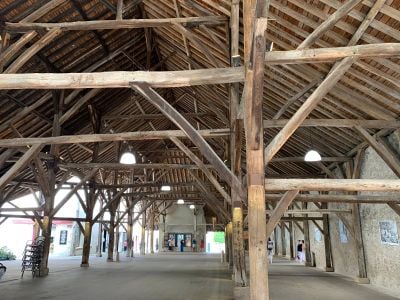
The Halles de Clisson is a 14th-century covered market in the centre of Clisson, Loire-Atlantique, listed as a classified historical monument since 1923. Its main nave, about 42 m long and 20 m wide, runs roughly east-west with two lower side aisles, covering some 900 m². The timber frame mixes oak, chestnut and fir, with posts resting on granite bases; four entrances open onto the rue des Halles, the place Notre-Dame, the place du Minage and the rue des Rémouleurs.
The halls stand on a market square recorded since the 13th century under Guillaume de Clisson, whose family sought income from sales taxes; a Maison du Minage collected grain dues nearby. Dendrochronology dates the oldest timbers to 1376-1377. In 1793 the Republicans defeated at Torfou burned Clisson, yet the halls survived, used as shelter by both sides. The town bought them in 1819 from the Prince de Condé and added a southern grain hall in 1821-1822.
The halls are still used for the weekly market, making them a gathering place for locals and visitors alike. The southern wing, once a grain hall, now houses the tourist office alongside a café and a bookshop.
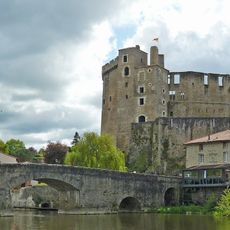
The halls have four entrances: west on Rue des Halles, east on Place Notre-Dame via a stone staircase from Rue Basse-des-Halles, south on Rue and Place du Minage toward the castle, and north on Rue des Rémouleurs. The tourist office occupies the south wing facing Place du Minage.
Excavations beneath the floor of the halls uncovered objects and bones linked to an old butchery, as well as traces of occupation going back to the 10th century. The wooden roof is built from three different types of timber, oak, chestnut, and fir, a combination that was unusual for the period.
The community of curious travelers
AroundUs brings together thousands of curated places, local tips, and hidden gems, enriched daily by 92,748 contributors worldwide.