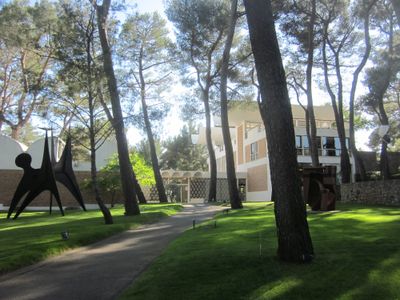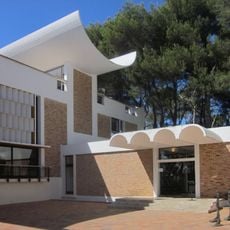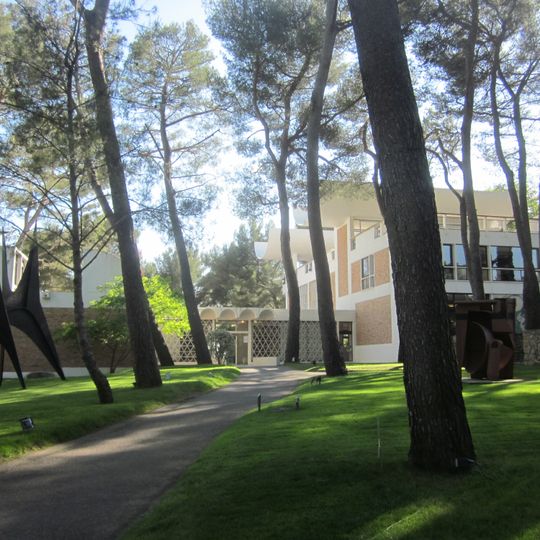
Labyrinth Miró, Sculpture garden at Fondation Maeght, Saint-Paul-de-Vence, France.
Labyrinth Miró is a set of sculptures and ceramics Joan Miró made for the Maeght Foundation between 1961 and 1981, laid out as a maze in a terrace garden above the sea. A white line marks the route, echoing Ariadne's thread, past a concrete arch of about 30 tonnes, a 12-by-2-metre ceramic wall of 468 tiles, and the Dea, a fertility figure with a ceramic tortoise-shell belly.
Aimé Maeght invited Miró to contribute to the Maeght Foundation in Saint-Paul-de-Vence in the early 1960s, and the artist designed the garden as a labyrinth. Miró worked with the ceramists Josep Llorens Artigas and Joan Gardy Artigas and with the architect Josep Lluís Sert. The ensemble was made between 1961 and 1981, with pieces such as the 1963 concrete arch, the 1968 ceramic wall of 468 tiles fired at Gallifa, and the 1973 bronze Fork.
The route is marked by a white line recalling Ariadne's thread, and a round grey ceramic table pays homage to Antoni Gaudí, echoing Park Güell in Barcelona. A green gargoyle feeds one of four basins, and the giant cosmic egg carries Miró's line: "L'œuf cosmique polarise les incertitudes de l'ombre et de la lumière."
A white line laid out like Ariadne's thread marks the route through the garden, but the path can be walked in any direction. The terrain is terraced between the mountains and the sea, with the highest terrace reached by steps and slopes. Sturdy shoes help on the uneven ground.
The white line marking the route alludes to Ariadne's thread from Greek myth, turning the walk into a literal thread through the maze. The ceramic wall, 12 by 2 metres, is made of 468 tiles fired in Artigas's workshop at Gallifa and set in 1968.
The community of curious travelers
AroundUs brings together thousands of curated places, local tips, and hidden gems, enriched daily by 92,777 contributors worldwide.