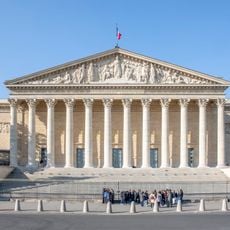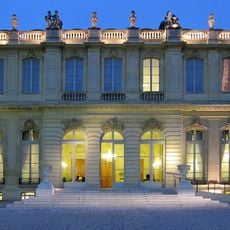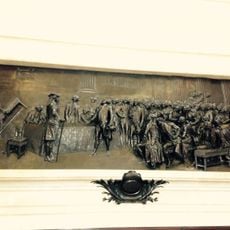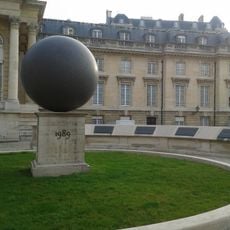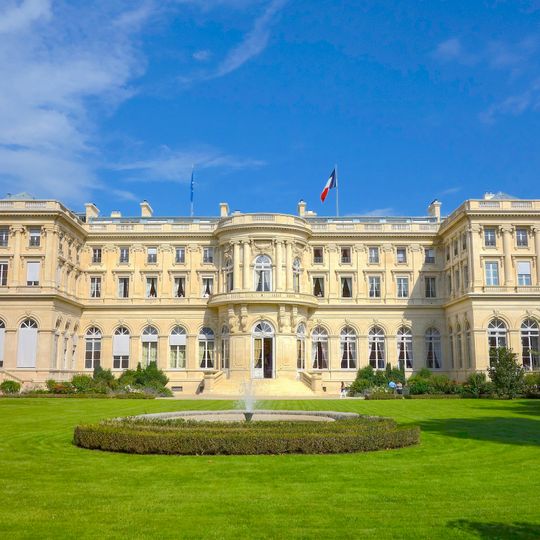
Ministry of Foreign Affairs building, Government building at Quai d'Orsay, Paris, France.
The Hôtel du ministre des Affaires étrangères at 37 Quai d'Orsay is a long, pale limestone building with a symmetrical facade. Its central rounded section carries a columned portico, a curved balcony over the entrance and a low dome with a flagpole; the wings have arched ground-floor windows, rectangular windows above, pilasters, dormer windows and a roofline balustrade. The cliquart stone came from the Fleury quarries at Clamart.
François Guizot initiated the project in 1844; the foundation stone was laid in 1845 with architect Jacques Lacornée and public works minister Pierre Sylvain Dumon present. Work stalled during the 1848 Revolution, resumed under Napoleon III and was completed in 1855. The building is of Lutetian limestone (cliquart) from the Fleury quarries at Clamart.
The building's ceremonial rooms mix Antiquity, Renaissance and classical elements, decorated by artists including Séchan, Nolau and Rubé, Molknecht, Liénard and the Huber brothers. The Salon de l'Horloge, the main reception room, takes its name from a clock by sculptor Victor Paillard; there Robert Schuman delivered the Schuman Declaration on 9 May 1950. The royal bathrooms, made in 1938 for King George VI and Queen Elizabeth, have mosaics by Auguste Labouret and furniture by Jacques Adnet.
The building sits along Quai d'Orsay beside the Seine and is easily accessible by public transport. The surrounding streets of the 7th arrondissement make it simple to explore on foot and view nearby government buildings and historical sites.
The Salon de l'Horloge, the main reception room, takes its name from a clock made by sculptor Victor Paillard; before World War I it was called the Peace Room, and earlier the Emperor's Room, Festival Room or Concert Room. Robert Schuman delivered the Schuman Declaration there on 9 May 1950.
The community of curious travelers
AroundUs brings together thousands of curated places, local tips, and hidden gems, enriched daily by 92,787 contributors worldwide.