Site archéologique du lac de Chalain, Archaeological site near Lake Chalain, France
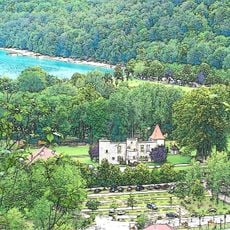
The archaeological site at Lake Chalain covers the western shore of the lake, between Fontenu, Marigny and Doucier in the Jura. Excavations revealed a pile-dwelling settlement occupied from about 4000 to 750 BC, with wooden posts, tools, textiles, leather and pottery preserved in lake sediments. The site is not open to the public; a scale model shows the rectangular houses with ridged roofs raised on wooden posts, and long wooden platforms laid flat in front of them.
The settlements were established during the Neolithic period and were repeatedly rebuilt over several millennia. The lake's recurring floods led to exceptional preservation of organic materials such as wood and fabrics.
The waterlogged sediments preserved objects rarely found at prehistoric sites: wooden tools, weapons, clothing, shoes, fabric, leather and pottery. The pile dwellings were occupied from about 4000 to 750 BC, spanning the Neolithic to the Bronze Age, and the finds show how these lakeside communities made and used everyday equipment.
The site is not open to the public. The finds, including a 9.35 m oak canoe preserved in the lake marl, are held at the Musée d'archéologie du Jura in Lons-le-Saunier, about 20 km southwest of Clairvaux. The site lies on the western shore between Fontenu, Marigny and Doucier.
The site is one of 111 prehistoric pile-dwelling sites around the Alps inscribed by UNESCO on 27 June 2011. Among the finds is a 9.35 m dugout canoe carved from a single oak trunk, kept intact in the marl of the lake shore.
The community of curious travelers
AroundUs brings together thousands of curated places, local tips, and hidden gems, enriched daily by 93,718 contributors worldwide.