Musée d'Histoire locale de Rueil-Malmaison, Local history museum in Rueil-Malmaison, France
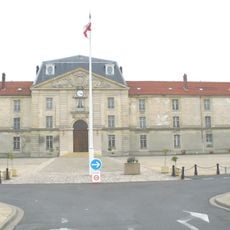
The Musée d'Histoire locale de Rueil-Malmaison occupies the former town hall built by architects Lebois and Prince, completed in 1869. Its red brick and cream stone facade rises three storeys to a grey slate roof with three towers, dormer windows and two tall chimneys. A broad stone staircase leads to the central arched wooden doorway, above which a stone pediment carries a round clock and the town's carved coat of arms.
The building was Rueil-Malmaison's town hall, built by architects Lebois and Prince for mayor Adrien Cramail; its first stone was laid on 24 May 1868 and it was finished the following year. On 1 September 1869 Napoleon III granted the town its coat of arms by decree for the inauguration. By 1978 it was too small for 60,000 inhabitants, so a new town hall was built and this one became a museum, inaugurated on 20 February 1982 by deputy-mayor Jacques Baumel.
The museum's holdings come from the town's own collections and deposits by the Société historique de Rueil, arranged thematically as the memory of Rueil. A room is devoted to Édouard Belin (1876–1963), inventor in 1907 of the bélinographe, a phototelegraphy process that sent photographs over distance and led to modern fax machines and photocopiers.
The museum occupies the former town hall on the town's main square, a building with a broad stone staircase up to the arched entrance. The ground floor is reached by these steps, and the three-storey facade with its clock pediment is visible from the square.
A room is devoted to Édouard Belin (1876–1963), born in Rueil, who in 1907 devised the bélinographe, a phototelegraphy process that transmitted photographs over distance and led to the modern fax and photocopier. The museum also keeps 1,600 figurines of Napoleon's Grande Armée.
The community of curious travelers
AroundUs brings together thousands of curated places, local tips, and hidden gems, enriched daily by 94,624 contributors worldwide.