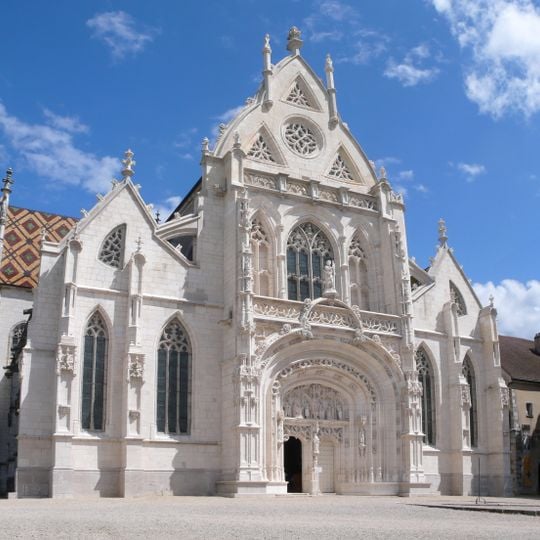
Royal monastery of Brou, Gothic monastery in Bourg-en-Bresse, France.
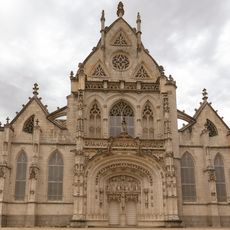
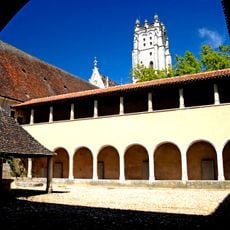
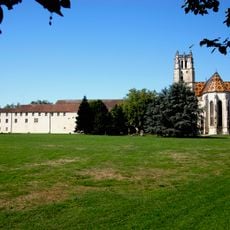
The Royal Monastery of Brou is a Gothic building in Bourg-en-Bresse with a distinctive roof of colored glazed tiles arranged in a diamond pattern and detailed stone carvings across its white facade. Inside, the building holds religious artworks including statues dating from the 13th to 17th centuries on the ground floor and paintings from the 16th to 20th centuries displayed in the upper areas.
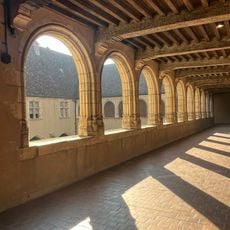
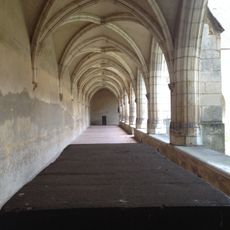
Around 927 Saint Gerard, bishop of Mâcon, founded a hermitage on this site and was buried here in 958; a priory dependent on Ambronay later stood on the spot. In 1506 Margaret of Austria bought the priory and founded the church and monastery, laying the first stone on 27 August; the church was consecrated on 22 March 1532. The Augustinians guarded the tombs until 1658, and in 1793–1794 the cloister housed the 1st Hussar Regiment, escaping demolition.
The church is dedicated to Saint Nicholas of Tolentino, whose feast day fell on the anniversary of Philibert's death. Augustinian friars from Lombardy guarded the tombs until 1658, when French Augustinians took over; the Revolution expelled them. In 1793-1794 the cloister sheltered the 1st Hussar Regiment, which spared it from demolition. Since 1922 the monastic buildings have held Bourg-en-Bresse's municipal museum.
The monastery can be visited daily and is easily accessible from the town center. Visitors should allow enough time to thoroughly explore the artworks and interior spaces.
Philibert's tomb has two effigies: the upper one in white Carrara marble shows him in ceremonial costume among putti, while below ten sibyls point toward it. Margaret of Austria's own tomb likewise carries an upper marble effigy and a lower alabaster one, where she appears young with unbound hair instead of the usual decayed transi figure.
The community of curious travelers
AroundUs brings together thousands of curated places, local tips, and hidden gems, enriched daily by 94,287 contributors worldwide.