Mont Caroux, Mountain summit in Hérault, France
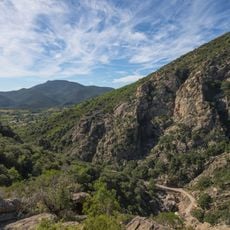
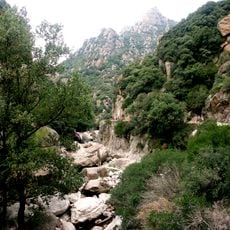
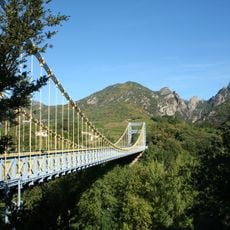
Mont Caroux is a gneiss massif whose plateau, about 2 km long, ends at 1,091 m. The Héric gorges bound it to the west and the Colombières gorges to the east, while the Orb valley lies to the south. Its south, east and west sides drop nearly 800 m in needles and ridges, whereas the north slope descends gently. The plateau is covered with broom gorse and heather.
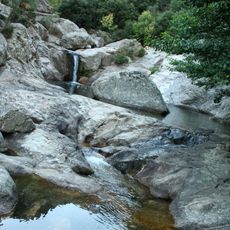
Marc-Antoine Azéma (1905–1954) made many first ascents on Mont Caroux, including the 600 m west ridge of the Aiguille Viallat. The three Aiguilles du Rieutord are named after their first climbers: Godefroy in 1910, Déplasse in 1911 and Viallat in 1912. The Tour Verte on the west flank was climbed in 1931. The Caroux and Héric gorges together form a protected listed site within the Haut-Languedoc Regional Nature Park.
The mountain's name comes from Occitan "Car", of pre-Celtic origin, plus the Roman suffix "-os", meaning "provided with rock". Locally it is called the "reclining woman" or "lying woman" because its profile resembles a woman's body.
The summit plateau is reached on foot; the northern slope rises gently while the southern, eastern and western sides drop in cliffs of nearly 800 m. The gorges d'Héric border the massif to the west and the gorges de Colombières to the east. The plateau is covered in broom and heather, and the rock is gneiss, so expect stony, uneven ground.
The name Caroux comes from Occitan "car", meaning rock, with the Roman suffix -os, so it means "provided with rock". Locals also call the mountain the "reclining woman" or "lying woman" because its profile resembles a body. The three Aiguilles du Rieutord are named after their first climbers: Godefroy in 1910, Déplasse in 1911 and Viallat in 1912.
The community of curious travelers
AroundUs brings together thousands of curated places, local tips, and hidden gems, enriched daily by 94,115 contributors worldwide.