Musée de la Préhistoire du Grand-Pressigny, Prehistoric museum in Le Grand-Pressigny, France.
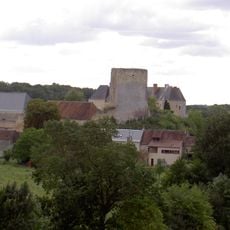
The Musée de la Préhistoire du Grand-Pressigny is housed in a medieval castle and displays collections of stone tools, pottery, and findings from regional excavations. The exhibits focus on objects from the Stone Age and explain how people lived and worked in ancient times.
The first museum opened in the town hall in 1922 through the efforts of Doctor Edmond Chaumier (1853-1931). The Friends of the Prehistoric Museum association was created on 26 June 1935 to secure a curator for the collections. After the castle gallery and display cases were fitted out in 1952, the collections moved there and the new museum, supervised by prehistorian Gérard Cordier, was inaugurated in 1955. A contemporary building by German architect Bernd Hoge completed the site in September 2009.
The museum's name comes from the Pressignian, a Neolithic industry defined by blades up to 40 cm long struck from flint nodules shaped like the region's 19th-century butter moulds, called "livres de beurre". These blades and daggers were exported as far as Switzerland and the Netherlands.
The museum occupies the castle of Le Grand-Pressigny and a contemporary building by German architect Bernd Hoge added in 2009; the visit runs through both. Collections span the Middle Palaeolithic, around 100,000 years ago, to the Bronze Age, between 1,400 and 1,800 BC. Allow time for the flint collections and the castle gallery.
The flint blades found here were so valued that they were traded across long distances during the Stone Age, reaching as far as Switzerland and the Netherlands. These widely distributed tools show how important this region was in early trade networks.
The community of curious travelers
AroundUs brings together thousands of curated places, local tips, and hidden gems, enriched daily by 92,927 contributors worldwide.