Ouvrage Kerfent, Military fortification in Faulquemont, France
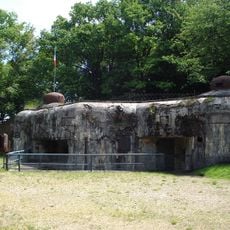
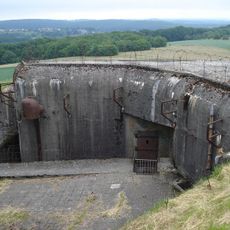
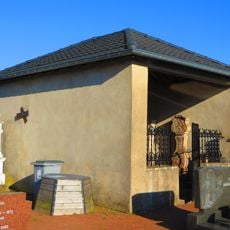
Ouvrage Kerfent is a petit ouvrage of the Maginot Line with three infantry blocks and a separate observation block 514 metres away. The blocks are linked by galleries up to 30 metres deep. Block 2 served as the entry, with a grille and armoured door, two GFM cloches and a grenade-launcher cloche. The concrete was poured in 1932.
Approved in October 1931 and completed in 1932 by the contractor Borie of Paris at a cost of 16 million francs, Kerfent was built as a petit ouvrage after budget cuts removed its planned artillery blocks. On 21 June 1940 the German 167th Infantry Division attacked from the rear, knocking out the cloches with 88mm guns; Captain Georges Broché surrendered around 10:00, one of five Maginot ouvrages taken before the armistice.
The name Kerfent comes from a wood north of Route Nationale 3. The garrison drew men from the 156th Fortress Infantry Regiment, the 163rd Position Artillery Regiment and the 2nd and 18th Engineer Regiments. Two Renault 6-115 diesel engines, each 54 hp at 750 rpm, drove the generators, and engine cooling relied on water circulation.
The ouvrage lies near Zimming, between the petits ouvrages of Mottemberg and Bambesch. The underground galleries are flooded with up to a metre of water and are not safely accessible, so entry is not possible. A volunteer group has been organized to interpret the site to the public; contact them or local museums for information on visiting the exterior.
From 1958 to 1961 the Canadian 601st Communications Squadron used the ouvrage as a communications centre supporting RCAF Station Grostenquin, and a microwave antenna was erected on Block 2. After the site passed to the commune of Zimming, that military antenna was replaced by a civil television antenna.
The community of curious travelers
AroundUs brings together thousands of curated places, local tips, and hidden gems, enriched daily by 94,600 contributors worldwide.