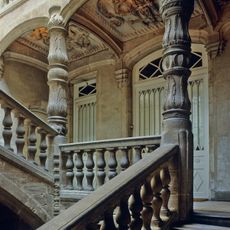
Musée d'art et d'archéologie du Périgord, Archaeological museum in Périgueux, France.
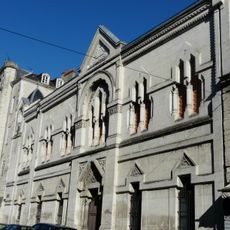
The Musée d'art et d'archéologie du Périgord occupies a building constructed between 1895 and 1898 to plans by the Limoges architect Charles Planckaert, its first stone laid by President Félix Faure. The pale stone facade has three tall arched openings above which MVSÉE DV PERIGORD is carved, with stone heads and brackets between the arches. Inside, an east wing, a west wing and a garden cloister hold the collections.
The institution was founded in the 19th century and has been collecting objects from the region and beyond ever since. It became known for its large holdings of stone age finds, particularly from when people lived in the Dordogne.
The collection displays medieval objects from local excavations that reveal how people lived in this region over centuries. European artworks from different periods hang alongside pieces that artists brought back from travels to Oceania and Asia.
The museum occupies a former Augustinian convent, with the east wing, west wing and a garden cloister between them. The archaeological collections are on the first floor of the east wing, while the fine arts section fills the west wing. The building has been a Monument historique since 2020.
The non-European collection is the seventh largest in France, and the African pieces are displayed at the foot of the staircase, representing the Kota, Bembe, Anyi, Bambara, N'guere and Nagô-Yoruba cultures. The comparative ethnography behind these acquisitions was built around flint knapping, a skill that had vanished from Europe.
The community of curious travelers
AroundUs brings together thousands of curated places, local tips, and hidden gems, enriched daily by 93,292 contributors worldwide.