Palais du Roure, Historical monument and museum in central Avignon, France.
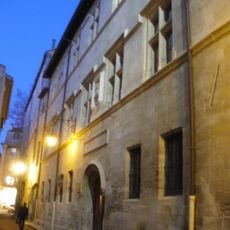
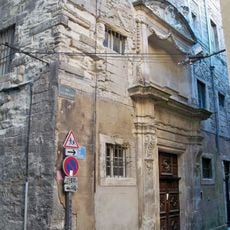
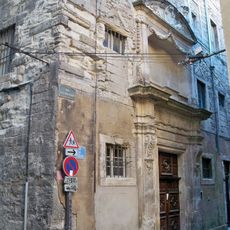
The Palais du Roure is a 15th-century hôtel particulier in Avignon, also known as the hôtel de Baroncelli-Javon. Its pale grey stone facade holds a dark brown wooden double door with three stacked panels per leaf and metal ring handles; above it, a stone arch is carved with interlacing bare vine branches, and a two-section pointed-arch window with diamond-patterned leaded glass sits directly above the carving.
In 1469 the Florentine Ghibelline Pierre Baroncelli bought a tavern called La Taverne du Mûrier and neighbouring houses in Avignon and turned them into his residence. The Baroncelli, close to legate Julien della Rovere, became an important Avignon family. In 1918 Jeanne de Flandreysy saved the building and made it a centre of Mediterranean culture; in 1936 her marriage to archaeologist Émile Espérandieu led to the Fondation Flandreysy-Espérandieu, inherited by Avignon in 1944. It was classified as a monument historique on 19 November 1941.
The palace holds collections about Provence's past and traditions, displaying objects that tell the story of local life and customs. These exhibits help visitors understand how this collection connects to the region's identity.
The palace welcomes visitors on weekday afternoons and offers both self-guided exploration and organized tours of the collections. It is best to check ahead for seasonal variations and any special exhibitions that might be on display.
Frédéric Mistral, who frequented the house, nicknamed it "palais du Roure" — palace of the oak — although the family name Baroncelli has nothing to do with it. The museum also keeps memorabilia of the British economist John Stuart Mill, who died in Avignon in 1873.
The community of curious travelers
AroundUs brings together thousands of curated places, local tips, and hidden gems, enriched daily by 92,787 contributors worldwide.