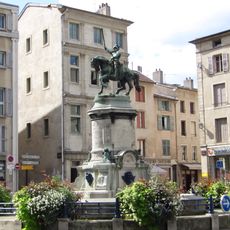
Obélisque de Nancy, Granite obelisk monument in city center, Nancy, France.
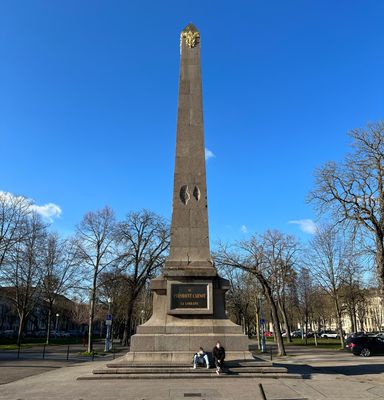
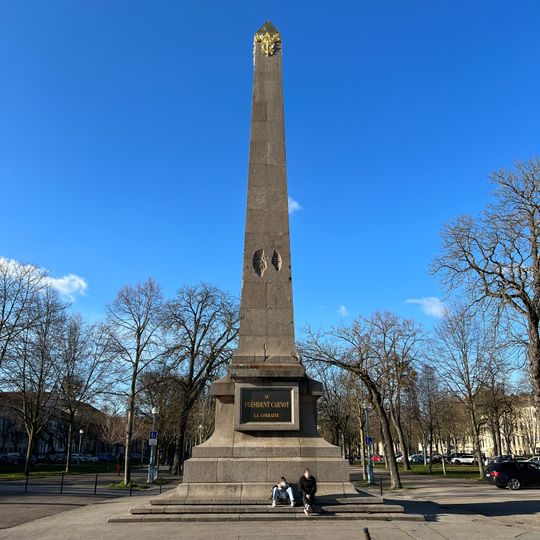
The Obélisque de Nancy is a tall granite pillar positioned in the heart of the city. The structure features clean geometric lines and proportions typical of French commemorative monuments from its period.
The obelisk was inaugurated on 28 June 1896, almost two years to the day after President Sadi Carnot was assassinated by the anarchist Caserio. It was funded by a public subscription that drew 28,000 subscribers and 865 Lorraine communes, plus a state grant of 12,000 francs. Charles-Désiré Bourgon was the architect, with sculpture by Victor Prouvé and ornament by Eugène Vallin. During the Second World War the bronze ornaments were removed and melted down under Vichy's non-ferrous metal mobilisation.
The alley where the obelisk stands is named allée de l'Obélisque after it. The monument also commemorates the meeting of Sadi Carnot with Grand Duke Constantin of Russia in Nancy in June 1892, linked to the Franco-Russian alliance. New enamel-lava plaques were inaugurated on 16 January 2016, dedicated to Carnot, the Grand Duke, the city and the three Lorraine departments of the time.
The monument sits in central Nancy and is easy to reach on foot from most parts of the city center. You can view and photograph it from various angles since it stands freely in the public square.
The bronze bust of Sadi Carnot, the allegories of Strength and Peace and the other ornaments were removed and melted down under the Vichy regime, during the non-ferrous metal mobilisation of the Second World War; only the pyramidion survived. In 1983 Doctor Berna, president of the Lorraine Academy of Sciences, proposed turning the obelisk into the gnomon of a giant sundial, but the city declined.
The community of curious travelers
AroundUs brings together thousands of curated places, local tips, and hidden gems, enriched daily by 94,048 contributors worldwide.