Orgues de Bort, Phonolite column formation in Bort-les-Orgues, Corrèze, France
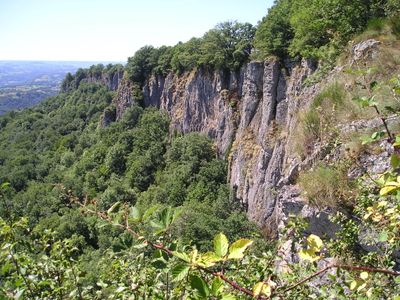
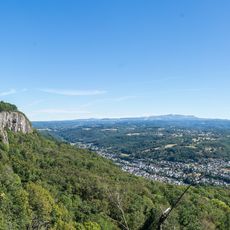
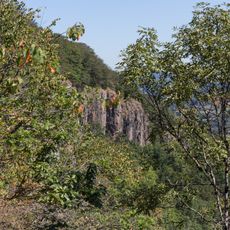
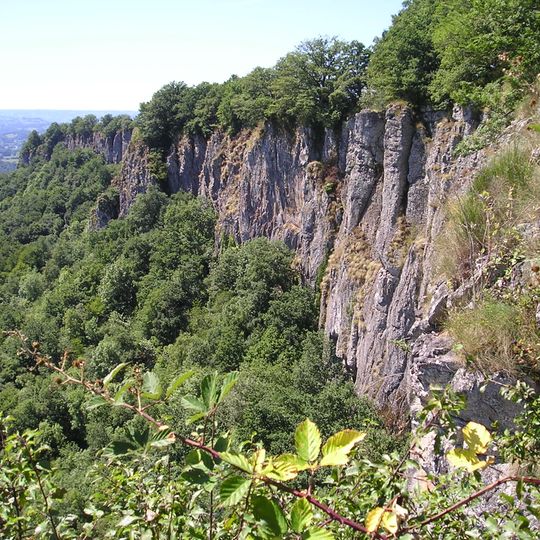
Orgues de Bort is a cliff of phonolite on the eastern face of the puy de Bort, above Bort-les-Orgues and the Dordogne valley. Its 1,500-metre wall is split into vertical polygonal columns, 80 to 100 metres high, that give the site its name. The rock is grey when fresh and weathers cream-coloured; blue and blackish haüyne crystals appear in the phonolite.
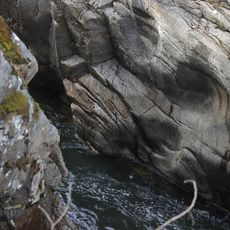
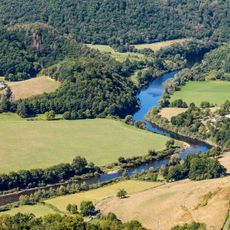
The phonolite flow of Bort-les-Orgues, dated to 8–6 million years ago in the late Miocene, came from a lava stage of the Cantal stratovolcano. It ran about 1,500 m and thickened to 80–100 m, damming the proto-Dordogne and pushing it east to its present course. Cooling formed the polygonal columns, later exposed by erosion in relief inversion.
The name likens the phonolite columns to organ pipes, a comparison already used in the 19th century and shared with other French sites such as the Orgues d'Ille-sur-Têt. At the southern end of the cliff wall stand a cave and several troglodytic dwellings cut into the rock, which visitors can look for below the columns.
The columns stand on the eastern face of the Puy de Bort, with a botanical trail and a belvedere on the plateau above; a car park, kiosk and refreshment stand are near the viewpoint. The 29 climbing routes, graded 3c to 6b, are on the left wall and climbable most of the year. A cave and several troglodytic dwellings sit at the southern end of the wall.
The left section of the formation features climbing routes that are accessible year-round and offer varying difficulty levels. This makes the site interesting not only for hikers but also for climbers looking for a natural training ground.
The community of curious travelers
AroundUs brings together thousands of curated places, local tips, and hidden gems, enriched daily by 93,953 contributors worldwide.