Parliament of Besançon, Classical palace in Besançon, France.
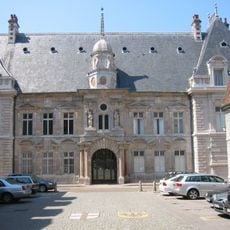
The Parliament of Besançon occupies the former second corps de logis of the hôtel de ville, now the city's palais de justice, built by architect Hugues Sambin. Its light warm-toned stone facade has pinkish columns, a central arched doorway with dark metal gates, grilled ground-floor windows, statues in niches, a circular window and a pediment, under a steep slate roof with dormers, tall chimneys and a central spire.
The institution was established in 1676 following the French capture of Besançon in 1674, replacing the previous parliament based in Dole. It represented the consolidation of French administrative control in the region after military conquest.
The court sat in the former second wing of the hôtel de ville, the present-day palais de justice. Its magistrates split into four chambers: the Grand'Chambre, the Tournelle, the Chambre des Enquêtes and the sovereign Chambre des Eaux et Forêts. By the Revolution it counted a first president, eight présidents à mortier and fifty-two councillors.
The former parliament building now houses the Palais de Justice of Besançon, so access is limited to the public areas of a working court. Visitors can view the facade, the arched entrance with its dark metal gates and the low iron fence from the street in the historic centre. Those wishing to enter should check the court's current conditions beforehand.
The Parlement blocked Louis XVI's 1779 decree against degrading practices towards serfs until 1787, one of the last regions of France to keep serfdom. Its first president from 1676 to 1702, Jean-Ferdinand Jobelot, had already led the Parlement of Dole, created in 1422.
The community of curious travelers
AroundUs brings together thousands of curated places, local tips, and hidden gems, enriched daily by 94,974 contributors worldwide.