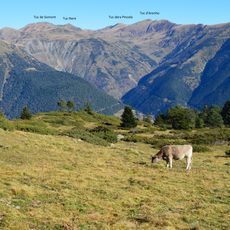
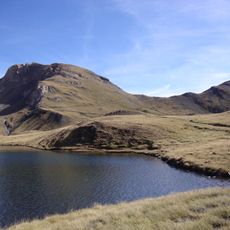
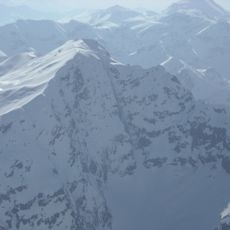
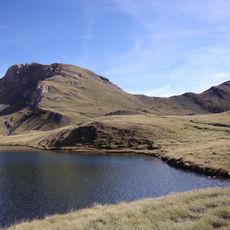
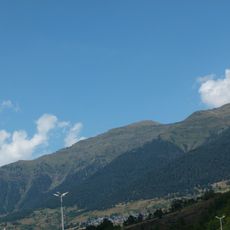
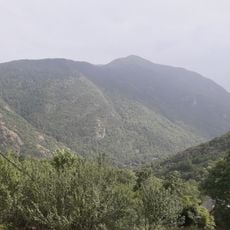
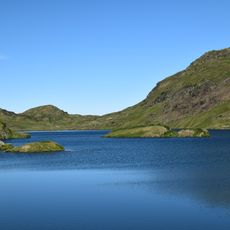
Tuc de Crabèra, Mountain summit between Sentein and Canejan, France and Spain
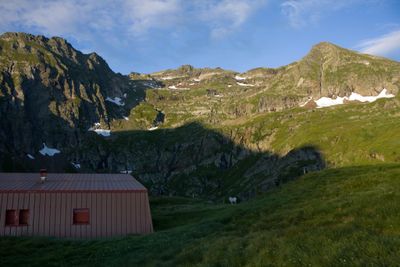
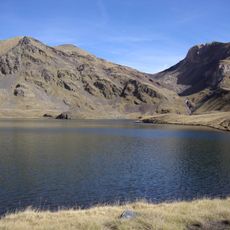
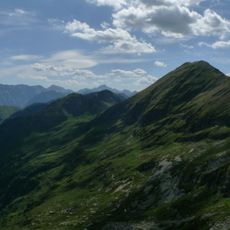
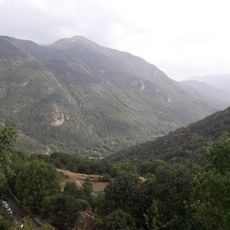
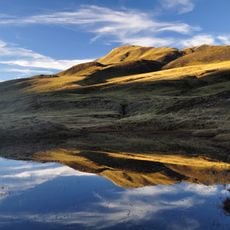
Tuc de Crabèra is a 2,630-metre summit in the central Pyrenees where the Ariège and Haute-Garonne departments of France meet the Catalan province of Lleida. Its slopes are built of schist, cut near the crest by long quartz veins, with scattered moraine deposits holding rounded granite blocks. The north-west flank above Melles is heavily wooded; the south side falls into Canejan in the Val d'Aran.
The first reintroductions of brown bears from Slovenia into the Pyrenees took place on the north-western slope of the Tuc de Crabèra. The females Ziva and Mellba were released in 1996, followed by the male Pyros in 1997. The summit itself lies at the tripoint of the French departments of Ariège and Haute-Garonne and the Catalan comarca of Val d'Aran.
The name Crabèra comes from the Occitan words cabra or craba, meaning "goat", and crabèr, crabèra, meaning "goatherd". The summit appears on the FEEC's list of the 100 cims, the 100 peaks catalogued by the Federació d'Entitats Excursionistes de Catalunya, which draws Catalan hikers to the border ridge.
The GR 10 long-distance trail passes the Jacques-Husson refuge near the Araing pond on the Ariège side; the refuge is staffed in season. The north-west flank above Melles is heavily wooded, while the south side climbs from Canejan in the Val d'Aran. Snow lingers on the upper slopes into early summer.
The peak rises only 54 meters above the nearby saddle and sits just 857 meters from its neighboring summit Tuc de Canejan. These modest distances show that the mountain is part of a continuous ridge rather than standing as an isolated peak.
The community of curious travelers
AroundUs brings together thousands of curated places, local tips, and hidden gems, enriched daily by 94,562 contributors worldwide.