Birlot tide mill, Tide mill in Île-de-Bréhat, France.
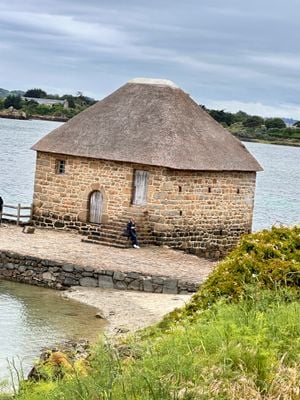
The Birlot tide mill stands on the western coast of Île-de-Bréhat's south island. It is a circular stone building with rough grey and tan masonry, a steep conical thatched roof, and a large arched opening at its base housing a wooden water wheel with dark spokes. Small square windows sit high on the walls, and stone steps with a low parapet descend along the right side.
It was built between 1633 and 1638 under the Duke of Penthièvre's rule. Island residents were required to have their grain ground there and pay a fee for the service.
The arched door's lintel carries the date 1744, marking major works at the mill. Grain was ground here until 1920, when a baker settled on the island and brought flour from the mainland; his bread was so liked that the mill stopped being profitable.
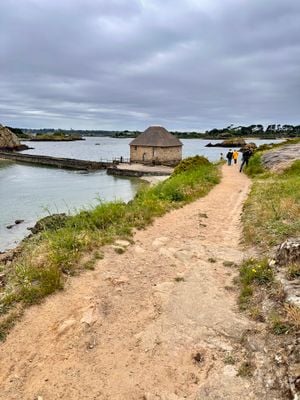
The mill stands on the western coast of Bréhat's southern island, along the Kerpont channel. Its wheel only turns when the sea has dropped enough, around mid-tide at Birlot, so time a walk to the falling water. The stone steps with a low parapet on the right side lead down beside the building.
The wheel cannot turn while submerged: the mill waits until mid-tide, then a sluice releases water from the pond behind it. It could run for six hours, three of falling and three of rising tide, twice in 24 hours as needed. The 1744 date is carved on the arched door's lintel.
The community of curious travelers
AroundUs brings together thousands of curated places, local tips, and hidden gems, enriched daily by 94,538 contributors worldwide.