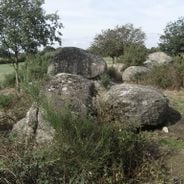
Pierre Tourneresse, Neolithic passage grave in Cairon, France
Pierre Tourneresse is a megalithic monument north of Cairon, set in a nearly circular mound 24 m in diameter edged by a dry-stone wall of limestone slabs. Its main chamber, about 4 m by 3 m, is reached by an 8.80 m corridor opening east; a smaller pear-shaped chamber opens west. The large upright stones alternate with dry-stone sections, and only one of the three original covering slabs remained in 1992.
This passage grave was built during the Neolithic period and served multiple generations as a burial place. Evidence found during excavations shows that people had inhabited the area before the monument was constructed.
The name Tourneresse links the monument to a regional legend: like the Pierre Tourneresse at Gouvix, the Pierre tournante at Fresney-le-Puceux and the Pierre Tournante at Livarot, it is said to turn on itself. The site is a monument historique inscrit since 19 May 1954.
The monument lies north of Cairon near the Vey valley, on terraced ground; the tumulus is about 24 m across and its east and west sides are missing, quarried in Gallo-Roman times. The main chamber opens east at the end of a corridor about 8.8 m long, the smaller pear-shaped chamber opens west. The covering slabs are gone, so the chambers stand open to the sky.
The main chamber was emptied during the Second World War, and the bones found were dumped into a nearby pit to the south. They belong to about eight individuals, at least five of them adults; a perforated canine found in the small chamber, which held a child's body, was probably a pendant.
The community of curious travelers
AroundUs brings together thousands of curated places, local tips, and hidden gems, enriched daily by 93,483 contributors worldwide.