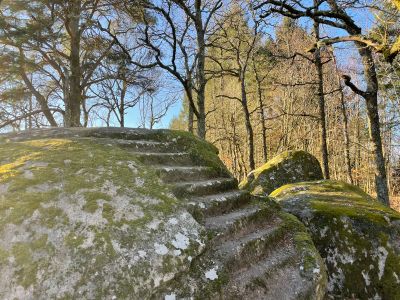
Pierre aux neuf gradins, Prehistoric megalith in Soubrebost, France.
The Pierre aux neuf gradins is a granite outcrop on a wooded hilltop in Soubrebost, Creuse, whose main block, about 2.5 m high, has nine roughly cut steps at least a metre wide and 10 cm high, a channel running down from the top, and a levelled summit platform left around two natural basins. Three stones show clear tool marks; a fourth, about 3 m high, stands in front.
The site's worked stones have no confirmed date or builder; the source records no excavation or dating. In 1895 Martin Nadaud described the nine steps and two basins in his memoirs, noting that villagers attributed them to Druids. A similar monument stands at the Castro de Ulaca in Spain, home of the Vettones.
In Limousin Occitan the site is called "La peira daus nòu esbalets", the stone with nine steps. Andrée Louradour recorded that water in the basins cured fever if a coin or pin was thrown in, and children's skin ailments if they were washed there; in the early 20th century the healed left a garment as thanks. Girls hoping to marry or wives seeking a husband's fidelity threw pins into a basin and drank its water.
The site remains open year-round and is reached via a marked trail through wooded ground outside the village. Sturdy footwear is essential since the terrain is uneven and the surrounding forest floor may be damp or slippery.
The main block's flat top was slightly cut to form a level platform while leaving two natural basins untouched; Martin Nadaud measured them in 1895 as 1 m by 1.57 m and 62 cm across, linked by a channel. A similar monument stands at the Castro de Ulaca in Spain.
The community of curious travelers
AroundUs brings together thousands of curated places, local tips, and hidden gems, enriched daily by 93,850 contributors worldwide.