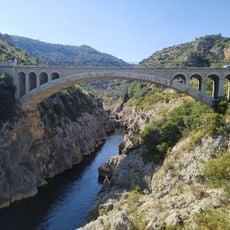
Gignac Bridge, Stone arch bridge in Gignac, France
Gignac Bridge is a stone arch structure crossing the Herault River with three distinct arches of varying sizes. Its solid stonework demonstrates traditional construction techniques and can be viewed from multiple vantage points along the riverbanks.
Bertrand Garipuy, Languedoc's director of public works, drew up the plans and work began in 1776; the first pier foundation was finished in 1780. Garipuy and his father died in 1782, and his nephew Ducros took over, completing the side arches by 1784. Paid partly in depreciating assignats during the Revolution, the bridge was finished in 1810 by engineers Billoin and Fontenay, and listed as a monument historique in 1950.
A plaque on the bridge's side calls it "Judged the most beautiful bridge of the 18th century", a verdict the Michelin Green Guide echoes. Since 1950 the bridge has been listed as a monument historique. Its three arches, dressed limestone and 50.72 m central span made it a reference work of Languedoc engineering.
The bridge carries the D619 (former N109) about 1 km west of Gignac; the A750 motorway now crosses the Hérault a few hundred metres downstream on the Languedoc Bridge, opened 11 June 2008. The deck is 9.80 m wide and the parapet low, so walkers should keep to the side. The three arches, 25.97 m each at the sides and 50.72 m in the centre, are best seen from the banks below.
Engineers created a small-scale model of the structure before starting construction to test the design and methods. This experimental approach allowed them to work out technical challenges before building the full-size version.
The community of curious travelers
AroundUs brings together thousands of curated places, local tips, and hidden gems, enriched daily by 93,151 contributors worldwide.