Prefecture hotel of Moselle, Administrative building in Metz, France
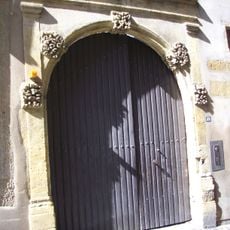
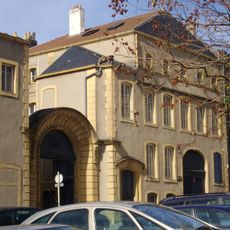
The Prefecture hotel of Moselle occupies the former Hôtel de l'Intendance, built 1738–1743 by architects Jacques Oger and Barthélémy Bourdet. Its U-shaped plan closes around a central cour d'honneur behind a concave porch block. Slate roofs are pierced by dormer windows, and the symmetrical masonry facades have cut-stone quoins and window surrounds. Under Napoleon III, Charles Pêtre carved the two eagles flanking the portal and the coats of arms of Metz, Sarreguemines, Thionville and Briey on the pediment.
Built between 1738 and 1743 as the Hôtel de l'Intendance for the generality of Metz, it was designed by Jacques Oger and Barthélémy Bourdet and is considered the first building of its kind in France. Partly ruined by a fire in 1803, it was rebuilt in 1806 on Napoleon I's order to house the prefecture of Moselle, a decision that anchored the state in the city through successive regimes.
The building has housed the prefecture of Moselle since 1806, when Napoleon I ordered its reconstruction after a fire in 1803. Under Napoleon III, Charles Pêtre carved the two eagles framing the portal and added the coats of arms of Metz, Sarreguemines, Thionville and Briey to the pediment. A sign reading "CONSEIL GENERAL" marks the left wing.
The building sits in a central location near public transportation and is easily visible from street level. Visitors can view the exterior architecture without restriction, though interior areas are typically not open to the general public.
The building was never a private mansion: it was purpose-built from 1738 to 1743 as the hôtel de l'Intendance of the généralité of Metz, the first edifice of its kind raised in France. Sculptor Charles Pêtre added the two eagles flanking the portal under Napoleon III, along with the coats of arms of Metz, Sarreguemines, Thionville and Briey on the pediment.
The community of curious travelers
AroundUs brings together thousands of curated places, local tips, and hidden gems, enriched daily by 94,048 contributors worldwide.