Pont-canal de la Tranchasse, Navigable aqueduct in Colombiers, France
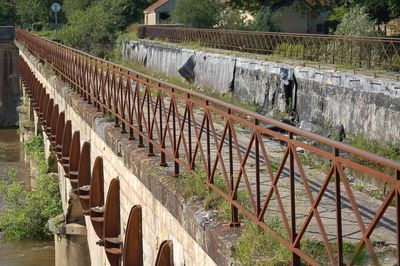
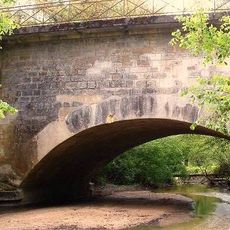
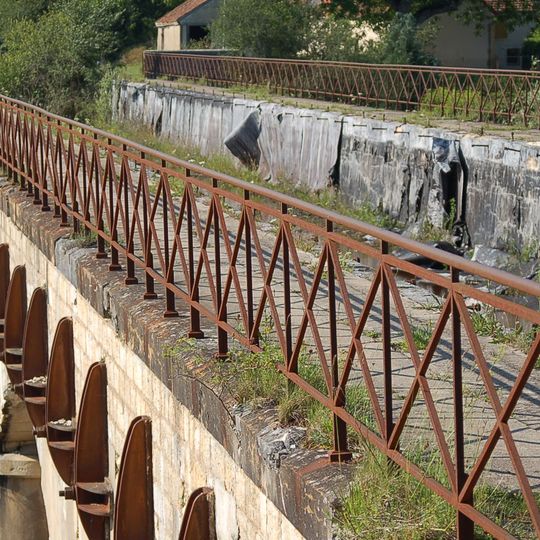
The Pont-canal de la Tranchasse is a disused canal bridge with eight low arches, 96 metres long and 8 metres wide, carrying a 5.50-metre-wide waterway over the Cher. Its rust-brown metal railing with X-shaped bars tops a wall of pale stone blocks set with dark oval plates. Grass grows between the blocks.
The project was proposed by engineer Charles Vauvilliers on 22 August 1822, and construction ran from 1829 to 1834; the design was by Joseph-Michel Dutens, a native of Tours. The local stone of the main structure weathered badly and froze, so restoration was already urgent by 1837. In December 1878 the downstream head collapsed over about 80 metres, and the masonry was consolidated with metal tie rods ending in cross-shaped anchors, while the piers were ringed with steel. The bridge carried traffic until 1955.
The aqueduct and lockkeeper's house show how water routes connected industrial areas across central France in the 1800s. Today, visitors can understand how essential this route was for moving goods between manufacturing centers.
A dirt path beside the former lockkeeper's house leads to a sandy area along the Cher River with a good view of the entire structure. The location is freely accessible and offers a natural vantage point to observe the aqueduct from close range.
In December 1878 the downstream head of the structure collapsed over about 80 metres. Repairs added metal tie rods ending in cross-shaped anchors to consolidate the masonry of the trough, and the piers were fitted with steel hoops. The oval plates visible on the stone wall belong to this reinforcement system.
The community of curious travelers
AroundUs brings together thousands of curated places, local tips, and hidden gems, enriched daily by 92,885 contributors worldwide.