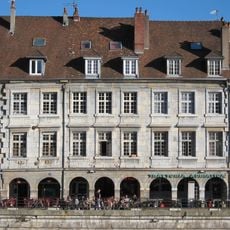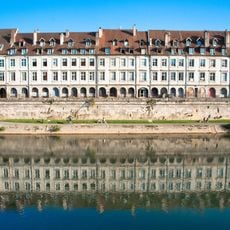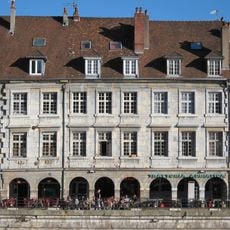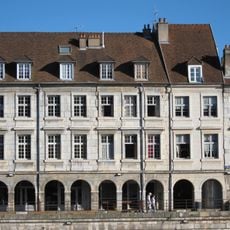
Battant bridge, Tram bridge in Besançon, France
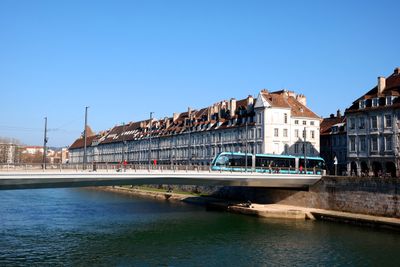
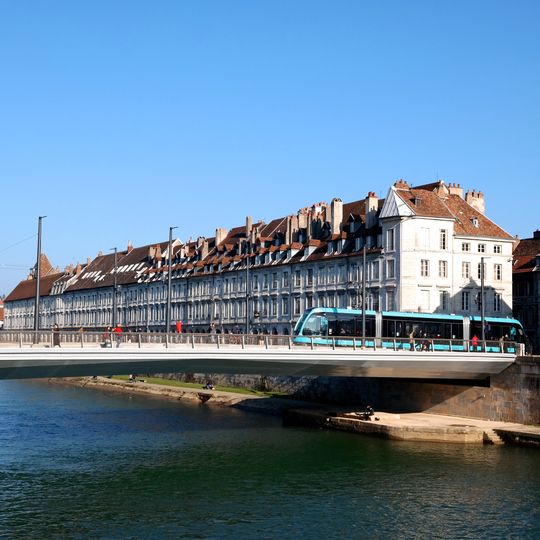
Battant bridge is a concrete bridge with a single shallow arch over the Doubs, linking the La Boucle and Battant districts between quai Vauban and place Jouffroy d'Abbans. Its flat deck carries a tram line and is edged by thin metal railings; the span rests on a stone abutment on the right bank. It replaced the Roman stone bridge in 1953, and a second modern structure took its place in 2013.
Built around 160 AD, the Roman bridge had seven arches of white limestone from Avrigney, its piers of polygonal stones held by iron clamps sealed with lead. It was Besançon's only crossing over the Doubs until the late 17th century. Repaired in 1453 and 1506, widened in 1688, it was saved from demolition in 1761 by engineer Jean Querret. Its last arch was destroyed in 1940 and 1944, and in 1953 it was replaced by a single-arch prestressed concrete bridge, itself replaced in 2013.
The bridge links La Boucle, the historic centre, with the Battant quarter between quai Vauban and place Jouffroy d'Abbans. In the Middle Ages the crossing was lined with stalls, and a fire started in a butcher's house near the fish hall on 30 June 1452 burned half of them; the last stalls went in 1841. A stone cross stood at its centre from the 13th century, was destroyed under the Revolution, restored, then removed in 1880.
The bridge links quai Vauban on the La Boucle side with place Jouffroy d'Abbans in Battant, and the tram crosses it with a stop nearby. A VéloCité bike station stands on place Jouffroy d'Abbans. The single arch lets floodwater pass freely beneath the deck.
The 1953 concrete bridge was demolished and replaced in 2013, leaving a single span that lets floodwaters and tourist boats pass freely. On the left bank, the base of a pier from the Roman bridge, built around 160, still survives.
The community of curious travelers
AroundUs brings together thousands of curated places, local tips, and hidden gems, enriched daily by 92,812 contributors worldwide.