Sables-d'Or-les-Pins, Breton seaside resort
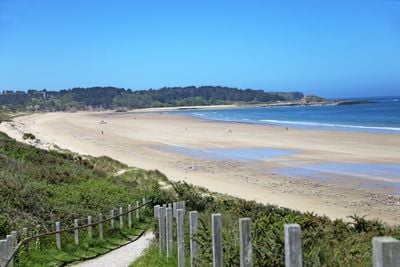
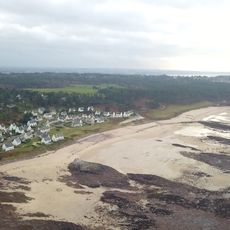
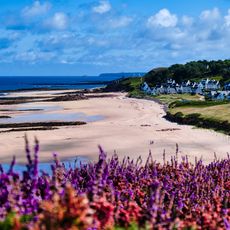
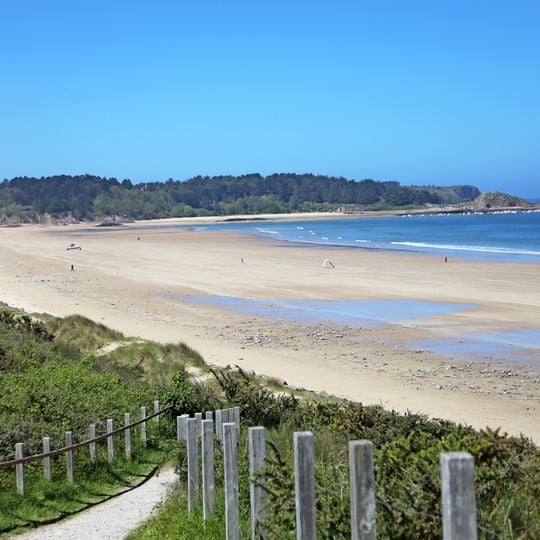
Sables-d'Or-les-Pins is a seaside resort on the Penthièvre coast in the Fréhel commune, built on dunes levelled at the mouth of the Islet river. Its long pale-tan beach curves along the shore, backed by a post-and-rail fence and low green vegetation, with a line of darker pebbles running parallel to the dunes. The resort extends southeast up a slope toward a plateau holding a golf course.
In 1921 promoters led by Roland Brouard bought just under 100 hectares of dunes from the Count of Couville near the Grève de Minieu to build a luxury resort. The Treyve-Frères landscape firm of Vichy drew the overall plan, and architect Yves Hémar designed the hotels, shops and most villas in an Anglo-Breton style. The Yffiniac–Matignon railway opened in February 1924, the Camping House hotel followed that June, a golf course in 1925 and a casino in 1927. The 1929 crisis halted development and Brouard died ruined in 1934.
The name means "Golden Sands the Pines", rendered in Breton as Traezhennoù Aour ar Pinoù. Promoter Roland Brouard aimed to rival Deauville and La Baule, and architect Yves Hémar gave the hotels, shops and villas an Anglo-Breton style meant to appeal to English visitors. The casino opened in 1927; the beach and dunes appear in Étienne Daho's song Tombé pour la France.
The grounds are easy to walk through and offer plenty of space between the villas for exploring. The closeness to the beach makes it simple to move between the water and quieter areas.
The resort preserves its planned layout from the early 1900s, making it a rare example of a completed vacation development. This coherence is still felt when walking through the regularly arranged streets and houses.
The community of curious travelers
AroundUs brings together thousands of curated places, local tips, and hidden gems, enriched daily by 92,927 contributors worldwide.