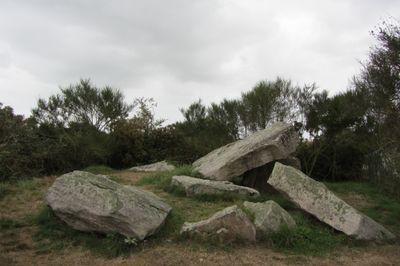
Dolmen de la Ville Hamon, Neolithic dolmen in Erquy, France
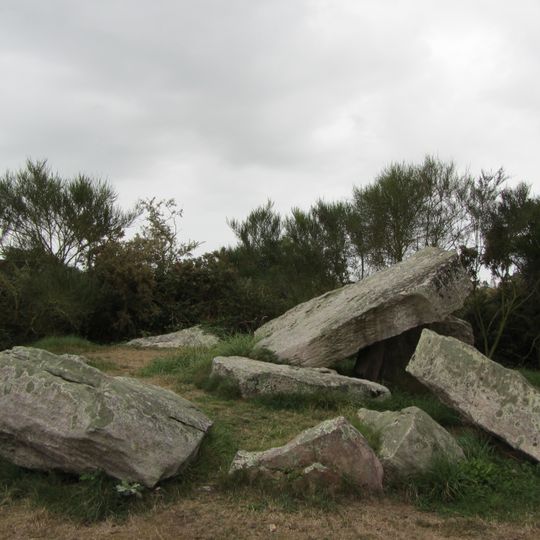
Dolmen de la Ville Hamon is a partly ruined gallery grave east of Erquy, built of pink granite from Erquy. One covering slab, 2.85 m long, 2.75 m wide and 0.39 m thick, still rests tilted on two upright stones; the other slabs lie scattered around it on a grassy mound, covering about 36 m². The passage opened to the south and held two chambers, one north and one south.
This burial monument was built in the Neolithic period as part of a widespread tradition of megaliths across the Breton coast. French authorities officially protected it as a historical monument in 1980, ensuring its preservation.
The monument is also called the Dolmen of Erquy, after the commune where it stands. Its slabs are pink granite, the stone known locally as grès rose d'Erquy, and the cover table measures 2.85 m by 2.75 m with a thickness of 0.39 m. The earliest records of the site come from documents held by the regional archaeology service in Rennes.
The site sits in southeastern Erquy and is easy to reach via well-marked walking paths with free access for all visitors. It lies close to the EV4 cycling route, making it convenient for cyclists exploring the region.
The monument is only partly ruined: one covering slab, 2.85 m long, 2.75 m wide and 0.39 m thick, still rests on two upright stones, while the other slabs lie scattered around it. The stones cover an area of about 36 m². Gaston de la Chenelière suggested the dolmen was never finished, though a southern entrance and two chambers have been identified.
The community of curious travelers
AroundUs brings together thousands of curated places, local tips, and hidden gems, enriched daily by 94,528 contributors worldwide.