Villa Paul Poiret, Modern architecture villa in Mézy-sur-Seine, France.
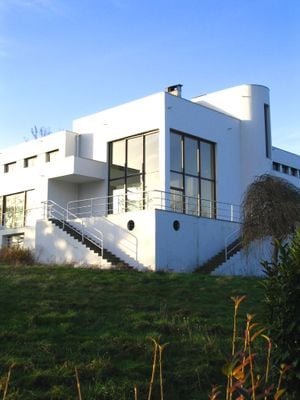
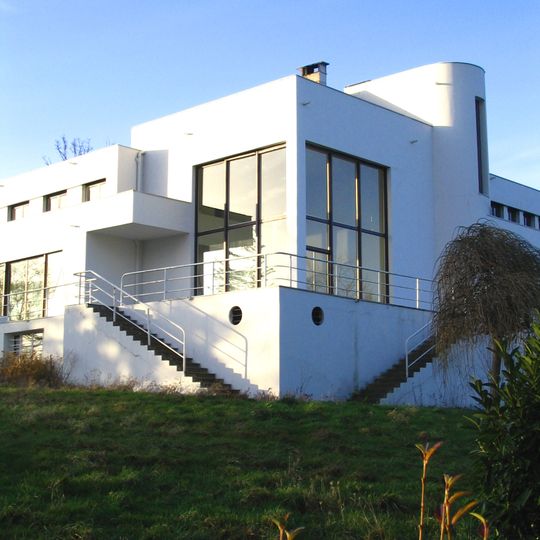
Villa Paul Poiret is a white, flat-roofed house of intersecting rectangular volumes on a grassy slope in Mézy-sur-Seine. Its main facade has dark-framed windows, including a tall corner window and a wide band, with two circular portholes on the lower wall. A white metal staircase climbs to an upper terrace, and a cylindrical tower with a narrow vertical window stands at the upper right.
Paul Poiret commissioned Robert Mallet-Stevens to design the villa in 1921, but work stopped in June 1923 with only the shell finished after the couturier's fashion house went bankrupt in 1926. The actress Elvire Popesco bought it in 1930 and had Paul Boyer complete it in 1932, adding porthole windows and steamship-style railings. It was listed as a monument historique in 1984.
The villa's nickname, "the paquebot" (ocean liner), comes from the porthole windows and bastingage-style railings added by architect Paul Boyer for actress Elvire Popesco in 1932. Popesco lived there until 1985, and the house appears in films including Holy Motors (2012) and Prête-moi ta main (2006). It opens to the public on European Heritage Days, the third weekend of September.
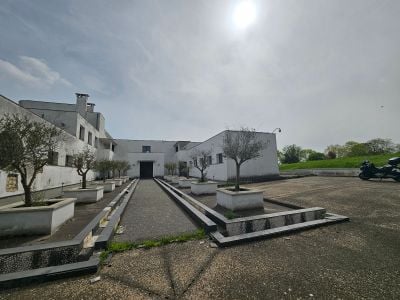
The villa stands at 32, route d'Apremont in Mézy-sur-Seine, on the slope of a hill called "le Gibet", within a 4.8-hectare park above the Seine valley. It is a private residence, opened to visitors only occasionally, notably during the European Heritage Days on the third weekend of September. The keeper's house on the grounds remains walled up.
The portholes and rounded terrace corners were added in 1932 by architect Paul Boyer for actress Elvire Popesco, who had bought the unfinished house from Paul Poiret in 1930. The nautical look earned it the nickname "the liner", and Popesco lived there until 1985.
The community of curious travelers
AroundUs brings together thousands of curated places, local tips, and hidden gems, enriched daily by 93,685 contributors worldwide.