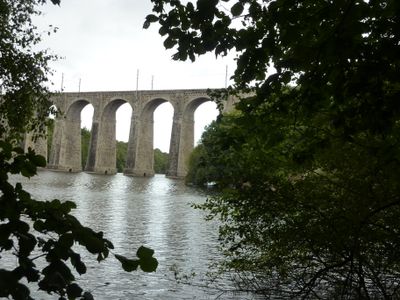
Viaduc de La Méaugon, Railway bridge in Ploufragan, France.
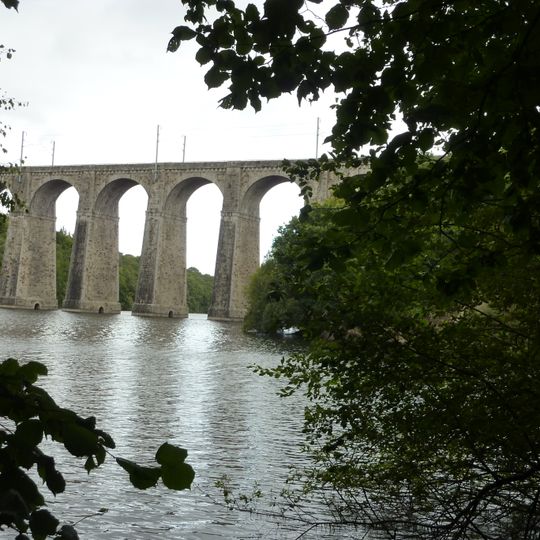
The Viaduc de La Méaugon is a granite railway viaduct between Ploufragan and La Méaugon, 228 m long and 58 m high, with two levels of arches: six lower arches of 12 m opening, now submerged by the Saint-Barthélémy reservoir, and twelve upper arches of 15 m opening. The piers taper toward the base, their faces outlined by darker recessed stonework, and a secondary deck lets pedestrians cross the Gouët.
The viaduct was built between 1860 and 1862 for the Compagnie des chemins de fer de l'Ouest, to carry the Paris-Montparnasse–Brest line across the Gouët valley after Saint-Brieuc station towards Guingamp. Its granite came from quarries opened near the construction site. It was inaugurated in 1862 at kilometric point 480.301, about 800 metres upstream of La Méaugon station.
The viaduct's name comes from the commune of La Méaugon, which it links to Ploufragan across the Gouët valley. Its granite was quarried near the construction site. Since the Saint-Barthélemy dam was inaugurated in 1978, the lower six arches have stood in the reservoir, and the secondary deck serves as a pedestrian crossing between the two banks.
The viaduct stands at kilometre point 480.301 on the Saint-Brieuc–Guingamp line, about 800 m upstream of La Méaugon station. A secondary deck lets pedestrians cross between the two banks, but since the Saint-Barthélemy dam was inaugurated in 1978, the water level of the Gouët reservoir can submerge that deck.
The viaduct has two levels of arches: six lower arches of 12 m span, now submerged by the Saint-Barthélémy dam reservoir, and twelve upper arches of 15 m span. A secondary deck lets pedestrians cross the Gouët from one bank to the other.
The community of curious travelers
AroundUs brings together thousands of curated places, local tips, and hidden gems, enriched daily by 93,657 contributors worldwide.