Viaduc de Morlaix, Railway viaduct in Morlaix, France.
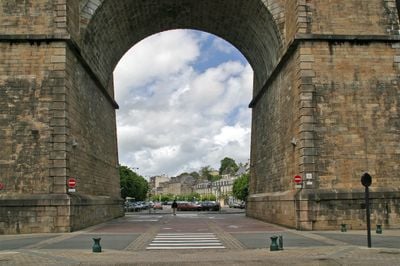
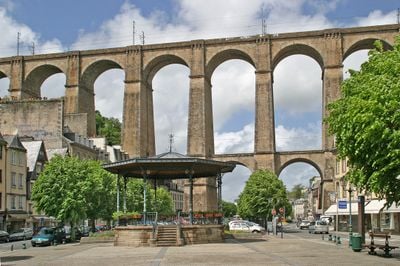
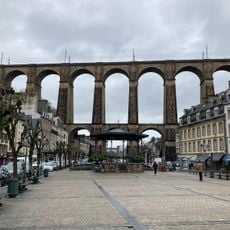
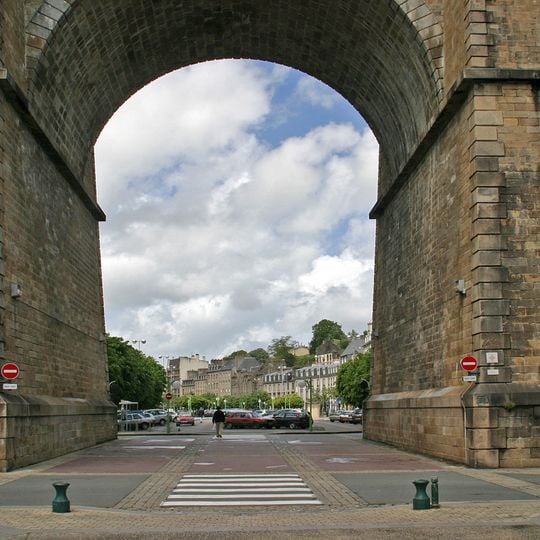
The Morlaix Viaduct is a granite railway viaduct crossing the Morlaix river valley on two tiers of arches: nine of 13.47 m span below and fourteen of 15.50 m above, reaching 62 m high over 292 m. Its piers taper from 19.36 m at the base to 11.16 m, and cut stone is limited to the arch surrounds, quoins and cornices, the rest being rough rubble. A footpath crosses the lower tier through passages in the piers.
Construction began on 20 July 1861 and took only 23 months despite winter stoppages. A first convoy crossed on 2 November 1863, hauled by 19 horses, and the line opened on 25 April 1865. From 1891 to 1967 a metre-gauge line to Carhaix used a third rail. On 29 January 1943 one bomb opened a 4 by 5 metre breach between the third and fourth piers, repaired within hours.
The viaduct stands beside the 15th-century church of Saint-Mélaine, whose tower it overtakes in height. Until the late 19th century the harbour reached as far as the bridge. A footpath on the first level links the two valley slopes, passing through small openings in the piers.
A footpath on the first level links the two slopes of the valley, passing through small openings cut in the piers. The Place des Otages and Place Cornic squares sit above the buried river; the Saint-Mélaine church stands right beside the viaduct. The station lies directly at the western end, on the plateau.
The 1860 council vote against the viaduct was not unanimous: 15 of 19 councillors judged that such a large structure would obstruct ventilation of a town squeezed into narrow valleys. The Compagnie des chemins de fer de l'Ouest ignored the objection and built it anyway. Look for the small red-and-white signs on the piers beneath the arches.
The community of curious travelers
AroundUs brings together thousands of curated places, local tips, and hidden gems, enriched daily by 94,095 contributors worldwide.