Toupin Viaduct, Railway viaduct in Saint-Brieuc, France.
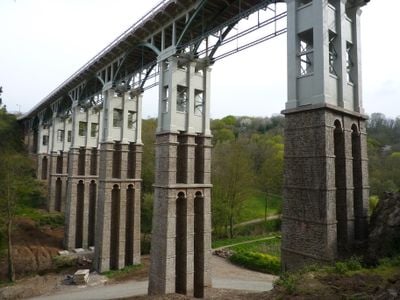
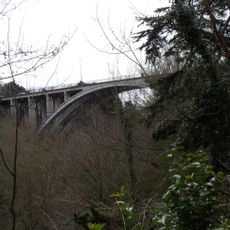
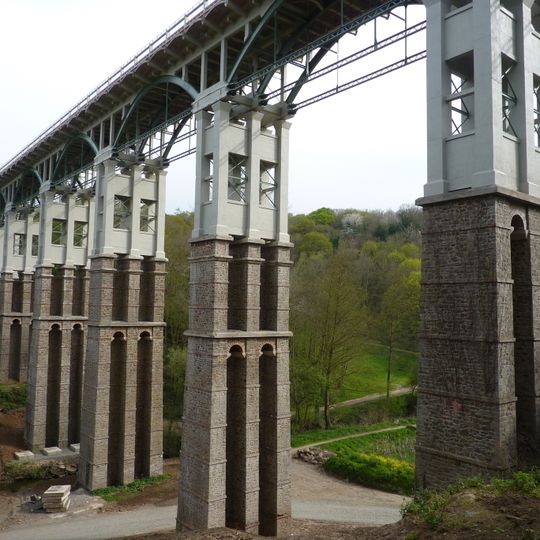
The Toupin Viaduct is a 179 m road bridge in Saint-Brieuc, its deck reaching 35 m above the ground. Rough light-brown masonry piers with vertical channels and arched openings carry light grey concrete sections, topped by a metal deck with dark green curved and diagonal steelwork. The piers are raised by 7 m reinforced-concrete pilettes.
The structure was built between 1902 and 1904 by engineer Louis Harel de la Noë for the Côtes-du-Nord railway network. It represented an important part of the region's growing railway infrastructure during the early 20th century.
The viaduct received official recognition as a registered historical monument on March 3, 2014, preserving its engineering legacy for future generations.
The viaduct now carries road traffic between the Europe district and the city centre of Saint-Brieuc, with a 30 km/h speed limit and a ban on heavy goods vehicles since the 2013–2015 works. Pedestrians use a widened pavement of 1.20 m, leaving 5.10 m for two car lanes. The deck is open to walkers and drivers, not to trains.
The construction combines traditional stone masonry with metal elements and reinforced concrete, showcasing building techniques from the early 20th century. This mix of materials was innovative for its time and allowed engineers to build a longer span while keeping weight manageable.
The community of curious travelers
AroundUs brings together thousands of curated places, local tips, and hidden gems, enriched daily by 94,536 contributors worldwide.