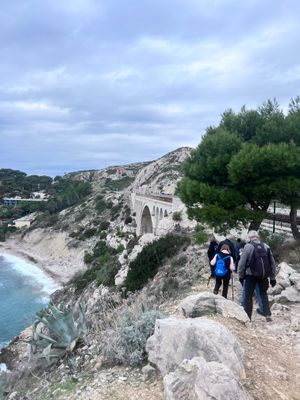
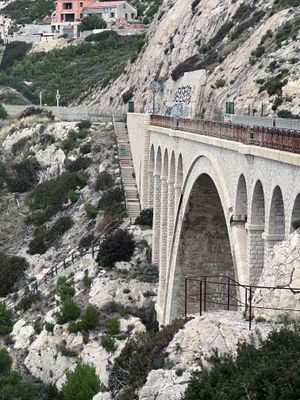
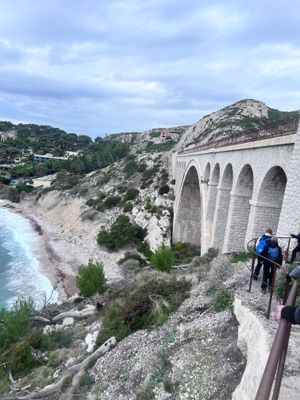
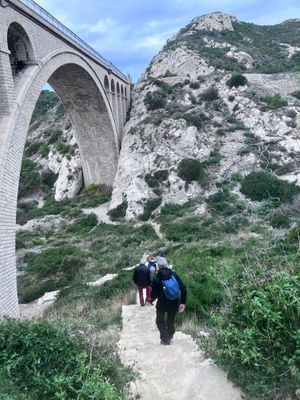
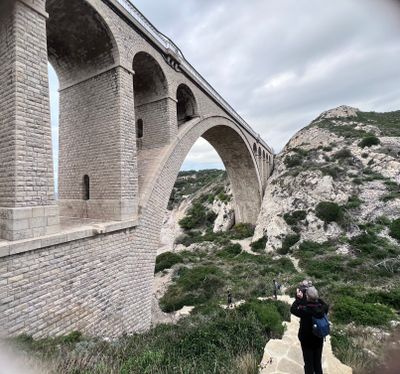
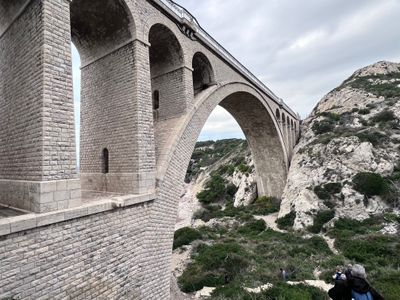
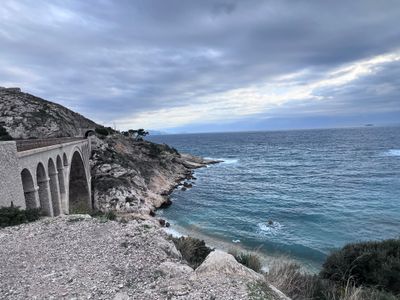
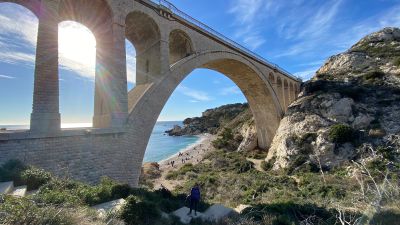
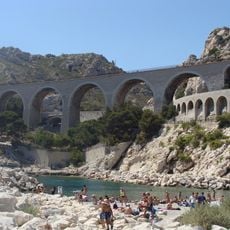
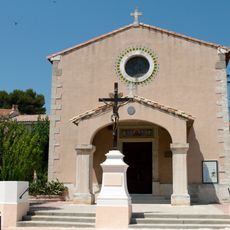
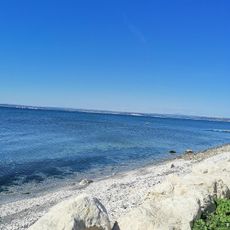
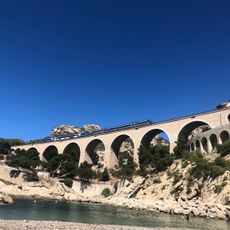
Viaduc des Eaux-salées, Railway bridge between Carry-le-Rouet and Ensuès-la-Redonne, France.
The Viaduc des Eaux-salées is a railway bridge on the Miramas–Estaque line, crossing the southern end of the Graffiane valley between Carry-le-Rouet and Ensuès-la-Redonne. Its masonry deck rests on a central arch of 50 metres span and 25 metres height, flanked on each side by five semicircular vaults of 5 metres opening. The total length is 143 metres, or 246 metres with the approach spans.
The Compagnie des chemins de fer de Paris à Lyon et à la Méditerranée obtained the concession in 1883 for a line from Miramas to L'Estaque via Port-de-Bouc, doubling the Miramas–Marseille section. Engineers Paul Séjourné and Alfred Delaly designed the viaduct, which was completed in 1914; the line opened to traffic in 1915. On 28 November 2000 the regional heritage commission of Provence-Alpes-Côte d'Azur awarded it the Patrimoine du XXe siècle label.
The bridge takes its name from salt water springs that naturally occur in this area and shape the character of the landscape. Visitors today can still discover these salty springs when exploring the paths beneath and around the structure.
The best way to visit the bridge is on foot using marked trails that run beneath and around the structure from the nearby villages. Visitors should wear comfortable shoes since some paths may include stairs or steep sections.
The main arch rests on foundations sunk 22 metres below sea level on the Estaque side, while the Miramas-side pier sits directly on rock about 5 metres above the water. The span itself measures 50 metres across and rises 25 metres.
The community of curious travelers
AroundUs brings together thousands of curated places, local tips, and hidden gems, enriched daily by 93,031 contributors worldwide.