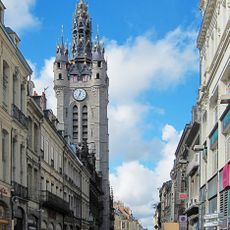
Église Notre-Dame de Douai, Gothic church in Douai, France.
Notre-Dame de Douai is a Primitive Gothic church of grey stone with a steep slate roof and a slender octagonal spire topped by a cross. Its sandstone and brick nave, from the late 12th century, carries a 15th-century wooden vault; the choir is 16th-century and the transept 15th-century. Inside, a high red-brick vault with pale stone ribs rises over three tall pointed windows, and a large wooden crucifix stands below the central lancet.
Notre-Dame is documented from 1175 and became a parish in 1257. Built over a 12th-century chapel, it was transformed from the 13th to the 15th century. Heavily damaged in 1944, it was restored and reopened in 1980, and has been a classified historical monument since 14 May 1962.
The church is tied to Douai's Clerics Parisians confraternity, the founding of the university, and the Gayant procession. Its Muhleisen organ, built in Strasbourg, has two manuals, a pedalboard, 29 stops and about 2,000 pipes; Denis Tchorek is its titular organist.
The church stands against the old town rampart, and the choir is visibly out of line with the transept, so look for the offset when you enter. The bell tower was rebuilt in 1971. The building was restored and reopened in 1980 after wartime damage, so parts of the interior date from that campaign.
The choir sits intentionally offset from the transept, reflecting a medieval belief that human builders cannot achieve divine perfection in their work. This subtle architectural detail reveals how theological ideas were literally built into the structure.
The community of curious travelers
AroundUs brings together thousands of curated places, local tips, and hidden gems, enriched daily by 92,836 contributors worldwide.