Église Saint-Denis-de-l'Estrée, Gothic Revival church in Saint-Denis, France.
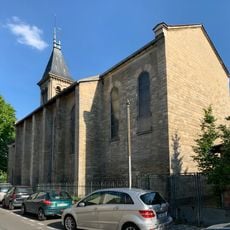
Église Saint-Denys-de-l'Estrée, known as the Église Neuve, is a light grey stone church on boulevard Jules-Guesde in Saint-Denis, built by Eugène Viollet-le-Duc. A square tower with a steep pyramidal roof, a clock face and corner spires stands beside a long slate roof pierced by pointed arches. Inside, pointed ribbed vaults cover the nave, a rounded apse holds tall blue and clear stained-glass windows above the altar, and a symphonic organ by Merklin Schutz dates from 1868.
A first church dedicated to Saint Denis stood here in the Merovingian era on the Gallo-Roman road Via Strata, which gave the name Estrée; it is cited in 834 and received Pope Innocent II in procession at Easter 1131. Ruined in 1567 during the Wars of Religion, it was replaced after the Revolution, when all the town's churches but the abbey and the Carmel chapel were destroyed. The Carmel chapel became too small, so the municipality commissioned Eugène Viollet-le-Duc to build the present church, consecrated to Saint Denis and known as the Église Neuve.
The name Estrée comes from the Via Strata, the Gallo-Roman road where a Merovingian church dedicated to Saint Denis once stood. In 1131 Pope Innocent II came here in procession at Easter, and in 1137 Abbot Suger installed a prior and twelve religious. The present building, called Église Neuve, faces the Basilica along the axis of the rue de la République.
The church stands on boulevard Jules-Guesde, at the end of rue de la République and on the axis of the royal basilica, whose facade faces east toward it. The square tower with its clock and corner spires marks the entrance side; inside, the tiled central aisle leads straight to the apse and its high stained-glass windows. The bell was cast in 1867 by the Rosier-Martin foundry.
The church is aligned on the axis of the royal Basilica of Saint-Denis, at the end of rue de la République, and was built while the basilica was being restored. Its bell was cast in 1867 by Prosper Rosier-Martin's firm Rosier-Martin, and its grand symphonic organ was made by Merklin Schutz in 1868. In January 2013, three hundred people from the Seine-Saint-Denis undocumented migrants' coordination occupied the church.
The community of curious travelers
AroundUs brings together thousands of curated places, local tips, and hidden gems, enriched daily by 93,015 contributors worldwide.