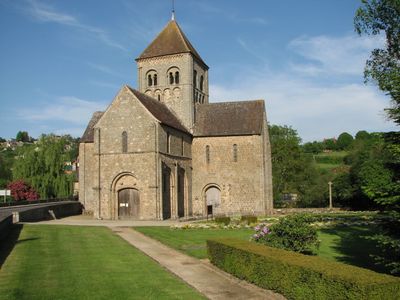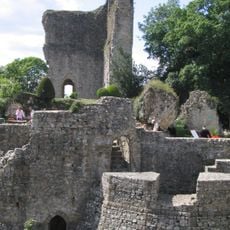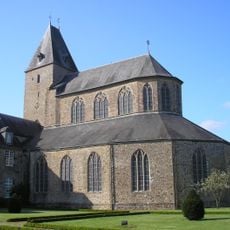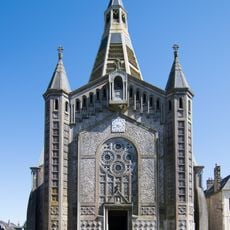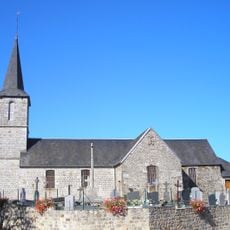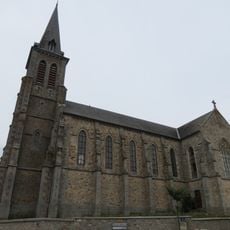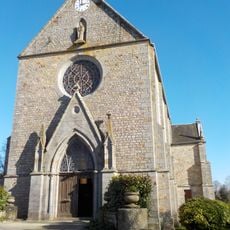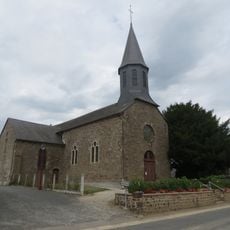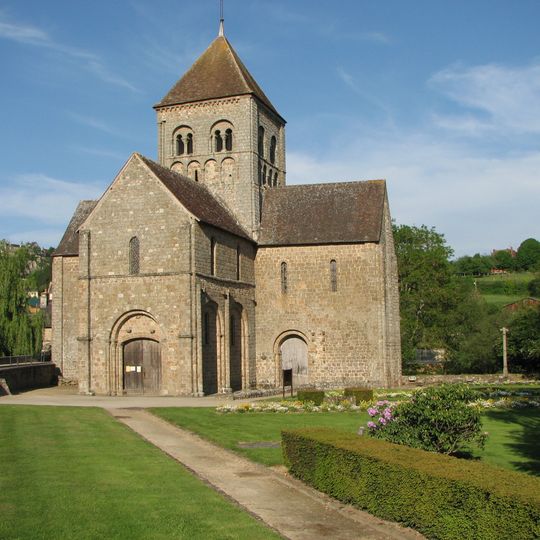
Église Notre-Dame-sur-l'Eau, Romanesque church in Domfront en Poiraie, Normandy, France.
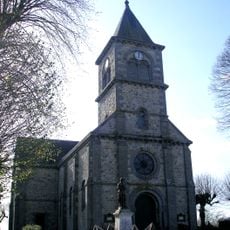
Église Notre-Dame-sur-l'Eau is a Norman Romanesque church whose square tower rises at the crossing, topped by a steep pyramidal roof and pierced by two levels of round-arched windows. The light beige stone facade keeps its original Romanesque portal with six columns and interlaced capitals, reset in the rebuilt wall. The transept is the most characteristic part, with cruciform supports whose half-columns run the full height, a rare arrangement in France.
The site was given around 1020 to Lonlay Abbey by William I of Bellême, founder of Domfront castle, and the church was built between the mid-11th century and about 1100, then dedicated in 1156. In 1162 Henry II Plantagenet had his daughter Eleanor baptised here. In 1836 four of the nave's six bays were cut off when the Domfront–Mortain road was opened, and in 1944 bombing hit the nave and bell tower.
The church holds a painted statue of the Virgin Mary from the 14th century that draws attention in the interior. Visitors can still see this carved artwork today, which reflects the region's devotion to Mary.
The church stands on a paved area with grass in front, on the site of Domfront en Poiraie in the Orne. The surviving nave is short, 9.45 m long and 7.50 m wide, so the visit is brief; the transept, with its cross-shaped supports, and the chevet are the parts to examine. The square tower rises over the crossing, and its stair is built into one pier.
The church was the only parish in Domfront during the Middle Ages, and Henry II Plantagenet had his daughter Eleanor baptised there in 1162; she later became the grandmother of Saint Louis. The square tower stands at the crossing of the transept, with its staircase built into one of the pillars.
The community of curious travelers
AroundUs brings together thousands of curated places, local tips, and hidden gems, enriched daily by 93,018 contributors worldwide.