Église Saint-Pierre de Cholet, Catholic church in Cholet, France.
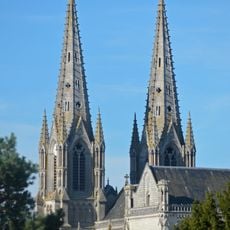
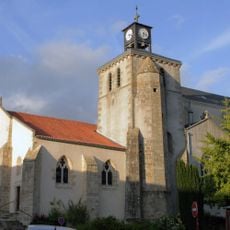
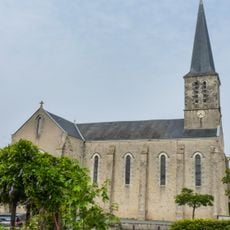
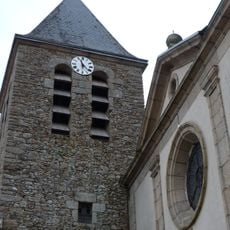
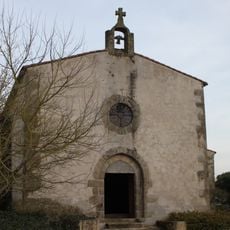
The Église Saint-Pierre de Cholet is a Catholic church on the Livet hill, built from 1752 by priest Jean Bougère and architect Alfred Tessier. Its grey-beige stone front has a steep central tower with a slender spire, flanked by two round clock dials, and two pointed-arch doorways at ground level. A smaller turret with a pointed roof stands to the right, and a round window sits above the right-hand portal.
A first church dedicated to Saint-Aubin stood on the Livet mound from the 5th–7th centuries and was destroyed by the Normans around 845. After the year 1000 the monks of Marmoutier built a Romanesque church, reworked in Gothic style at the end of the 15th century under the priest Thibault Carté. Rebuilt from 1752, it kept a covered wooden gallery until 1850; the present church was built by the priest Jean Bougère and the architect Alfred Tessier, and its bell tower was finished in 1933.
The parish patron, Saint Peter, stands atop the bell tower: an 850-kilo statue designed by architects Benaitreau and Rabjeau, holding the keys of paradise in one hand and blessing with the other. The tower was blessed on 2 December 1934 by Joseph Rumeau, bishop of Angers. A list of the successive parish priests runs from Thibault Carté (1384-1406) to Matthieu Lefrançois in 2018.
The church stands on the Livet mound in the Câlins working-class district, its spire visible across the neighbourhood. A 600 m² jardin de curé with more than 200 plant species borders the building, so allow time to walk around the outside as well as inside.
The church is bordered by a 600 m² jardin de curé holding more than 200 plant species, a green space tied to the parish rather than a public park. It lies on the Livet hill, in the former bourg Saint-Pierre, above the working-class Câlins district that the spire overlooked for nearly ninety years.
The community of curious travelers
AroundUs brings together thousands of curated places, local tips, and hidden gems, enriched daily by 94,356 contributors worldwide.