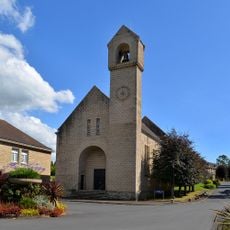
Église Sainte-Croix de Saint-Lô, Medieval church in Saint-Lô, France
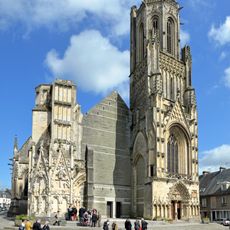
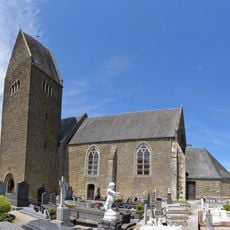
The Église Sainte-Croix is a former abbey church in pale yellow masonry, with a long body under a steep dark slate roof. Its left end has a tall tower-like section with narrow openings; the upper wall carries small arched windows above a larger arcade of round arches. The right section projects with a rounded apse and a deep arched entrance, and a large carved letter "I" sits between two arched windows.
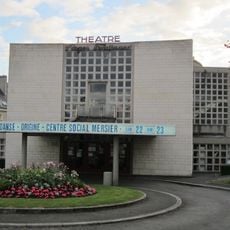
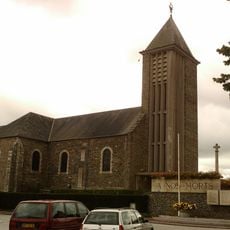
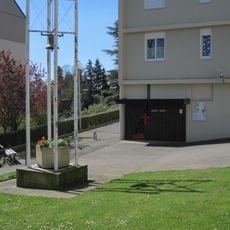
Built in the 13th century as the abbey church of the Augustinian abbey of Sainte-Croix, which disappeared after the Revolution. It was heavily remodelled in the 19th century under the Second Empire in Neo-Romanesque style, keeping its west portal and some Romanesque capitals thanks to Mérimée. In 1944 the 1860 bell tower collapsed under bombardment; in 1957 Marcel Mersier erected a concrete campanile on the parvis.
The west porch carries a carving of Paganism in chains, a bound man held by two figures, and a tympanum showing Saint Laud's miracle of restoring sight to a blind woman. Inside, Romanesque capitals depict the weighing of a soul, Christ on the cross and a working goldsmith.
The 1860 bell tower collapsed in 1944 and its ruins are where Major Howie's body was laid; the concrete campanile by Marcel Mersier now stands on the parvis. Inside, look above the west portal for the 1892 Louis Debierre organ, restored by Jacques Nonnet and inaugurated in 2003. The 2006 restoration of the two altars cost €23,601.
The three skulls of Jean de la Roche-Tesson, Guillaume Bacon and Richard de Percy, executed in 1344, were taken down from the town walls by Edward III in 1346 and buried in the abbey church; work under its paving in 1746 brought them back to light.
The community of curious travelers
AroundUs brings together thousands of curated places, local tips, and hidden gems, enriched daily by 94,464 contributors worldwide.