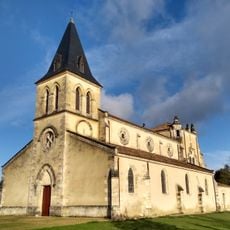
Église du Vieux Lugo, Romanesque church in Lugos, France
Église du Vieux Lugo is a Romanesque church in Lugos featuring a main nave, choir section, and a bell tower built in the 15th century to replace an earlier wall-mounted bell structure. The stone structure retains its medieval layout and is protected as a historical monument.
The church, dedicated to Saint Michael, was built in the 11th century in blocks of iron-rich sandstone (alios or garluche). The choir and nave date from the 11th or 12th century. The present bell tower replaced an earlier wall-mounted bell structure in the 15th century; the bell still in place bears the date 1643. A chapel dedicated to Notre-Dame was added south of the choir in the 17th century and now serves as the sacristy. The church was abandoned around 1849 after a new parish church was built in the village.
The name Lugo may derive from the Aquitanian "lur agor", dry land, or from the Celtic god Lug. The church stood where two routes to Santiago de Compostela met, the Tours road and the "English road" through Soulac and Mios, and a hostel for pilgrims may have existed here. On the north wall of the apse, a small opening about a metre above ground, now glazed and barred, is called a veyrine; one explanation is that it let infants be passed in for baptism.
The building is protected as a historical monument and managed by the local municipality. Contact the local authorities in advance to arrange a visit, as access may be limited.
On the north wall of the apse, about a metre above the ground, a small opening is now closed by a stained-glass window and a grille. It is a veyrine, and one explanation holds that it let infants be passed into the church for baptism; others say pilgrims or lepers used it.
The community of curious travelers
AroundUs brings together thousands of curated places, local tips, and hidden gems, enriched daily by 94,658 contributors worldwide.