Mane Braz dolmens, Neolithic dolmen complex at Erdeven, France
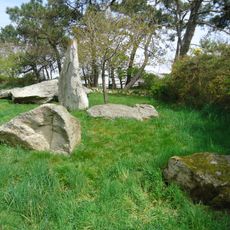
Mane Braz is a group of five passage dolmens on a natural hill about 30 m high near Erdeven. The largest, the southeast dolmen, has a nearly square chamber of 4.80 by 4.30 m divided into four cells, each with its own capstone. The northwest group of three dolmens lies within one cairn, and the northeast dolmen is heavily ruined. Two grey stone chambers with dark openings are visible side by side.
The site was explored by W. C. Lukis in 1867, G. Chaplain-Duparc in 1877 and F. Gaillard in 1890; Gaillard found many vases in the middle gallery. The dolmens were classified as monuments historiques by decrees of 24 October 1921 and 12 March 1923, and Z. Le Rouzic restored the site in 1923. Le Rouzic's finds, including pottery fragments, a polished axe, a barbed arrowhead and flint scrapers, are kept at the Musée de Préhistoire de Carnac.
The name Mané-Bras means "moor of the great mountain" in Breton, fitting a natural hill about 30 m high. The site holds five passage dolmens: three share one cairn and open southwest, while the largest, the southeast dolmen, opens east and is divided into four cells by crossing slabs. One passage slab carries an engraved "shield" motif with a cephalic form and a lateral crook.
The site is freely accessible and located along the Chemin des Megalithes walking path, allowing you to wander at your own pace. Visit on a dry day since the ground can become slippery, making it harder to move safely between the stone structures.
The largest dolmen, in the southeast, has a chamber divided into four cells by two slabs along the passage axis and two perpendicular to it, each cell with its own capstone. One passage slab carries an engraved "shield" motif topped by a head-like form and a lateral crook.
The community of curious travelers
AroundUs brings together thousands of curated places, local tips, and hidden gems, enriched daily by 94,546 contributors worldwide.