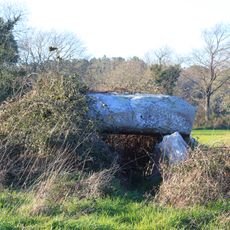
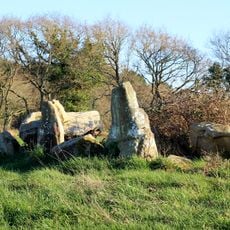
Dolmen de Crucuno, Neolithic dolmen in Plouharnel, France.
The Dolmen de Crucuno is the surviving square chamber of a passage dolmen, 3.40 m long and 3.35 m wide, enclosed by nine upright stones between 1.35 m and 2.10 m high. A capstone 5.20 m long, 3.80 m wide and 0.77 m thick rests on them; one orthostat bears cup marks.
The dolmen is the surviving chamber of a passage grave that once ran 27 m long. The passage was demolished at the end of the 19th century, and its stones were used to build the surrounding houses of Crucuno. The State acquired the monument in 1882, and it was classified as a monument historique on the 1889 list.
One of the chamber's upright stones carries cup marks, small circular hollows pecked into the granite. The source records them without explaining their purpose. The monument also served as a shelter, a barn and a fair-day tavern, according to Félix Gaillard, who reported that villagers found axes here.
The dolmen stands in the middle of Crucuno hamlet, in Plouharnel, so you reach it on foot from the village lanes; the surrounding houses were built with stones from its demolished passage. The chamber is about 1.80 m high, so you can step inside. The site is state property, classified since 1889.
The capstone measures 5.20 m long, 3.80 m wide and 0.77 m thick. The chamber it covers is nearly square, 3.40 m by 3.35 m, framed by nine upright stones between 1.35 m and 2.10 m tall. One of these orthostats carries cup marks.
The community of curious travelers
AroundUs brings together thousands of curated places, local tips, and hidden gems, enriched daily by 93,863 contributors worldwide.