Vénus de Quinipily, Historic sculpture in Baud, France.
The Vénus de Quinipily is a granite sculpture depicting a naked woman with hands on her chest, standing about 2.2 meters tall on a pedestal. A large monolithic basin sits beside the figure, completing the monument within its garden setting.
The sculpture dates to antiquity and was originally positioned near a Roman camp before being moved to its current location in 1696. This relocation shows how the figure was relocated across centuries and reflects the Roman presence in the region.
Latin inscriptions on the pedestal reference Caesar and Venus Victrix, connecting this work to Roman traditions. Visitors can still see these inscriptions today and understand why this figure holds meaning in the local history.
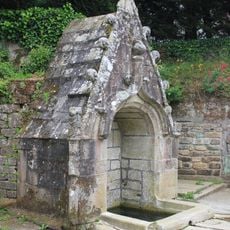
The statue stands in the park beside the ruins of the Château de Quinipily, about 1.5 km southeast of Baud. It is set on the lintel of a monumental granite fountain, with the monolithic basin of roughly 3,500 litres in front of it. The figure faces visitors at close range, so the mottled granite and the Latin inscriptions carved on the four faces of the fountain can be read on foot.
The statue was not carried off by the current: it was thrown into the Blavet on purpose, in 1661 and again in 1670, and pulled out by locals in 1664 and by Pierre de Lannion in 1695. The second immersion followed a mutilation that cost the figure one breast and one arm.
The community of curious travelers
AroundUs brings together thousands of curated places, local tips, and hidden gems, enriched daily by 94,089 contributors worldwide.