Gare de Saint-Hippolyte, Historical railway station in Saint-Hippolyte, France.
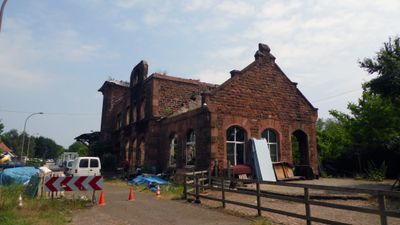
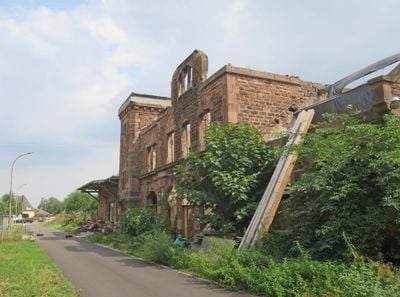
Gare de Saint-Hippolyte is a ruined two-storey station building of reddish-brown stone blocks, with a central gable and a tall gabled wing on the right. Its facade has tall arched openings, some with dark grilles, and the roof is missing over the right side, exposing the stone gable wall. A large white panel leans against the front.
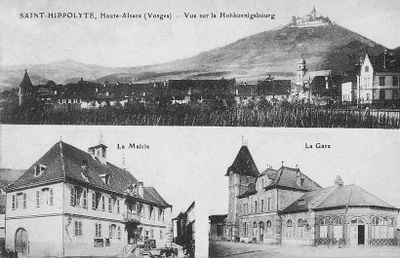
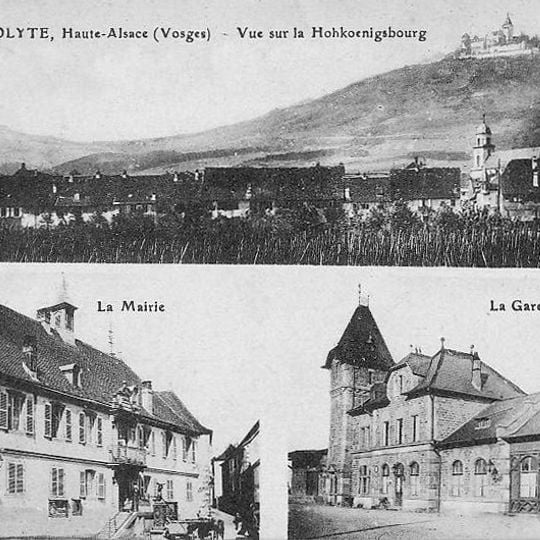
The station opened on 18 October 1840, when the Compagnie du chemin de fer de Strasbourg à Bâle began operating the Benfeld–Colmar section; it was a third-class station added to the final route after public consultation. In 1903–1907 a new stone reception building by architect Ludwig Kriesche was built for Kaiser Wilhelm II's visits to the Haut-Koenigsbourg works, with a tower and a Fürstenzimmer. The ticket office closed in 1976 and trains stopped calling around 2002.
Locals call it the "Kaiserbahnhof" or "gare du Château du Haut-Koenigsbourg" because tourists once stepped off here to climb to the castle ruins. Wilhelm II was met on the platform by the village children during his visits. The station also appears in a scene of Claude Chabrol's film La Décade prodigieuse.
The site sits at about 180 meters elevation and lies outside the village center, making it less accessible without personal transport. Since it now functions as a private residence, interior visits are not possible, but the exterior facade can be viewed from the surrounding area.
The 1903–1907 building was planned by architect Ludwig Kriesche and built by Bodo Ebhardt, who directed the Haut-Koenigsbourg restoration. A first-floor room with two windows was reserved for Wilhelm II, and village children greeted him on arrival. A field railway linked the station to the castle building site.
The community of curious travelers
AroundUs brings together thousands of curated places, local tips, and hidden gems, enriched daily by 94,534 contributors worldwide.