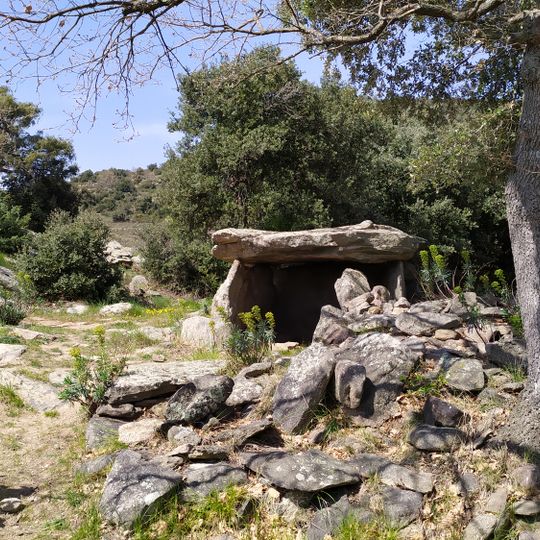
Dolmen de la Barraca, dolmen in Tarerach, France
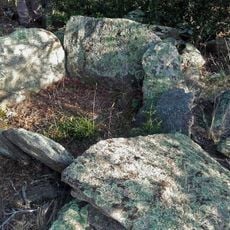
The Dolmen de la Barraca, also called Dolmen I of Mas Llussanes, is a megalithic chamber at Tarerach built of five local granite orthostats, not schist. A massive capstone 3.30 m long and 2.35 m wide rests on these uprights, forming a roughly trapezoidal room that opens to the south-southeast. Smaller slabs narrow the entrance, and the chamber sits within a circular mound about 6 m across.
Built between the 5th and 2nd millennia before Christ, with most structures dating to around 3000 before Christ, the site later served as shelter after its funeral use ended. Its name 'La Barraca' meaning 'the hut' in Catalan suggests people in later times used it as a refuge from weather.
The two dolmens lie near the hamlet of Mas Llussanes in Tarerach, Dolmen II about 200 m south-east of Dolmen I, in a rocky chaos that merges with its mound. Dolmen I, La Barraca, opens to the south-south-east and keeps its 3.30 m capstone; Dolmen II opens to the south-west and has lost its cover slab. Approach on foot and watch the uneven, stone-strewn ground.
Dolmen I was first mentioned by Pierre Vidal in 1921 and excavated by Jean Abélanet in 1975. The dig yielded an unfinished disc or ring of green stone, 65 to 70 mm across, plus a large cardium shell. In the neighbouring vineyards, about ten quartz hammerstones and three similar rings were found, pointing to a Vérazien-type settlement.
The community of curious travelers
AroundUs brings together thousands of curated places, local tips, and hidden gems, enriched daily by 94,355 contributors worldwide.