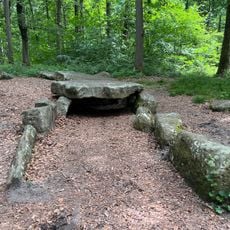
Allée couverte de la Pierre Plate, Gallery grave in Presles, France
The Allée couverte de la Pierre Plate is a Neolithic burial chamber in Presles built from stacked stones and topped with cover slabs. The interior space extends approximately 11 meters in length and narrows gradually toward the back, with walls where bones were systematically arranged.
Known since the Middle Ages, when the site was cultivated rather than wooded, the gallery grave was first excavated in 1912-1913. Bernard Bottet carried out a complete excavation in 1926, uncovering the remains of over 100 people. It was classified as a monument historique on 19 October 1932 and restored in 1970-1971.
The site is named La Pierre Plate, referring to the flat stone that defines the structure. The arrangement of the stones reveals how Neolithic people honored their dead and the importance they placed on creating a lasting resting place.
The entrance slab is 3.30 m wide and 1.70 m high, pierced by a rectangular opening 0.63 m wide and 0.82 m high with rounded corners. The chamber averages 1.75 m in height, so adults must stoop. The site lies in the L'Isle-Adam forest, 2 km southwest of Presles, near the A15 motorway.
The first cover slab near the entrance bears a polissoir on its inner face, a smooth worn patch used for polishing stone tools. Excavator Bernard Bottet also read a natural hollow at the base of the entry slab as the socket of a lamp, though the plug closing the opening was never found.
The community of curious travelers
AroundUs brings together thousands of curated places, local tips, and hidden gems, enriched daily by 92,926 contributors worldwide.