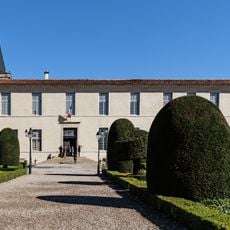
Jardin de l'Évêché de Castres, French formal garden in Castres, France
The Bishop's Garden is a French formal garden in Castres with six parterres: two boxwood embroidery beds near the palace, whose scrolls can suggest a fleur-de-lis, an Occitan cross and a bishop's hat, and four English-style beds around a central basin with yews, sages and hydrangeas. A chestnut grove and a kiosk close the garden, bordered by two rows of lime trees.
Michel Tubeuf, bishop of Castres until 1682, had the episcopal palace built by Jules Hardouin-Mansard from 1666 to 1673; the town wall bordering the first garden was demolished in 1676. Sources disagree whether Tubeuf, his successor Augustin de Maupeou, or both commissioned the French garden, but all attribute its design to André Le Nôtre, who by tradition never visited and worked from plans of the buildings and terrain. A 1726 dictionary called it "very beautiful"; it was listed in 1992 and classified on 27 July 1995.
The garden received recognition as a Historic Monument in 1995 and was designated an Outstanding Garden in 2004 for its French classical design. Visitors can read the space as a symbol of episcopal authority expressed through its symmetrical layout and precise geometric forms.
The garden lies behind the former Bishop's Palace, now the Town Hall, with the Theater nearby. A straight gravel path leads from the entrance to the central round fountain, dividing the beds into two mirrored halves. Two black metal lampposts with glass lanterns stand at the path edges, and a chestnut grove with a kiosk closes the far end, opposite the palace.
The garden preserves one of France's last remaining boxwood parterres with original patterns from the 17th century. This ornamental work spans a substantial area and demonstrates the craftsmanship required to create such gardens.
The community of curious travelers
AroundUs brings together thousands of curated places, local tips, and hidden gems, enriched daily by 93,916 contributors worldwide.