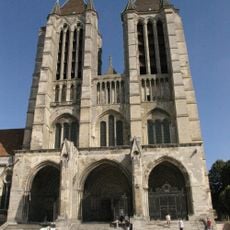
Musée du noyonnais, Municipal museum in Noyon, France.
The Musée du Noyonnais is housed in a former episcopal building and contains regional artworks, archaeological artifacts, and historical documents spanning Noyon's past. The collections range from pottery and coins to paintings and manuscripts that document aspects of daily life and local governance.
The episcopal palace was built from the 12th century: the Tour Roland housed the bishop, and the 1170s great hall survives as a two-bay arcature. Bishop Charles de Hangest added a Renaissance logis from 1501 to 1528, and Henri de Baradat rebuilt the medieval hall from 1630. Fire destroyed the palace in 1918; the town rebuilt it from 1924 to 1938, and the museum opened in 1948, settling permanently in 1982.
The museum keeps the treasure of Notre-Dame de Noyon cathedral, with chests from the late 12th to the 17th century and an 11th-century chess set. Carved stonework from the cathedral is displayed alongside paintings by Joseph-Félix Bouchor, a native of the region.
The museum occupies the former episcopal palace south of Noyon Cathedral, whose south flank the 1897 dismantling of the bishop's chapel was meant to clear. The palace was rebuilt identically from 1924 to 1938 after the 1918 fire, and the museum has been installed there permanently since 1982. Look for the Hangest arms on the main door of the 1501–1528 logis.
The museum's collections include an 11th-century chess set and chests from the late 12th to the 17th century from the cathedral treasury. The building also preserves the Tour Roland, a three-level medieval tower where the bishop lived on the top floor, and a 12th-century arcature with twin bays dated to the 1170s by its capitals.
The community of curious travelers
AroundUs brings together thousands of curated places, local tips, and hidden gems, enriched daily by 94,128 contributors worldwide.