Niderviller pottery, Historical earthenware factory in Niderviller, France
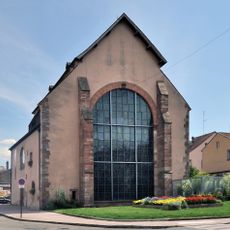
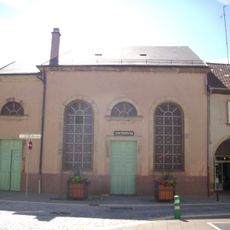
Niderviller pottery is a faience and porcelain manufactory in Niderviller, Moselle, founded in 1735. Its red Vosges sandstone building, erected on the site of an old seigneurial mill, has a steep dark-tiled roof and a tall round chimney of alternating light and dark brick. The pale facade has a large rectangular window with dark timber tracery and a smaller arched window with a white surround. The workshops produced tableware and figurines in deep magenta and pink, often with landscapes in purple camaïeu on a faux-wood ground.
The factory was founded in 1735 and changed hands several times, with each owner introducing new production methods. Under different management, it evolved from traditional faience techniques to innovative approaches and industrial-scale manufacturing.
The factory's wares are often compared to those of Sèvres, and its deep magenta or pink decoration is a recurring trait. A white glazed vessel in the collection shows a purple monochrome landscape with a tall tower, trees and rocks, framed by a pierced lattice of green and gold loops. In 1782 Custine sent a polychrome porcelain service to George Washington at Mount Vernon.
Collections of pieces from this factory are displayed in major museums like the Louvre and the Metropolitan Museum of Art. To understand the full story of production, visiting the site provides insight into the craftsmanship and hands-on techniques used.
During a specific production phase, the factory experimented with optical illusions on ceramic surfaces to create three-dimensional effects. These special trompe-l'oeil techniques demonstrate the artistic boldness and skill of the artisans working at that time.
The community of curious travelers
AroundUs brings together thousands of curated places, local tips, and hidden gems, enriched daily by 93,915 contributors worldwide.