Château de Tournebu, Medieval castle in Cinglais, Calvados, France.
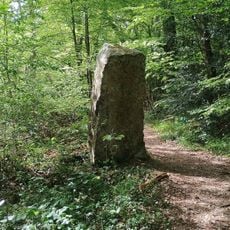
Château de Tournebu is a ruined stone keep standing behind trees on a rise, the last remnant of a castle destroyed after the Revolution. The keep is cylindrical outside and quadrangular inside, 21 metres high and 12 metres in diameter, with three levels marked by bands of large rectangular stonework. Its lower section is a broad blocky wall with a narrow window; above, a narrower shaft with small openings ends in a flat summit with corner projections, and vegetation grows on the upper ledges.
Built in the 12th century by the first barons of Tournebu, the keep was the last remnant of a castle destroyed after the Revolution. In 1452 it passed by inheritance to the Thère family, then through several owners; in 1701 Pierre de Tournebu bought it back from Frédéric-Charles Rhingrave de Salm. It was inscribed as a monument historique on 21 June 1927.
The stonemasons left geometric patterns carved into the keep's stones, which reveal how medieval craftsmen worked. These marks show the care that builders took in their construction methods centuries ago.
The ruins are private property and not open to visitors, but can be viewed from outside via local paths and roads. It is recommended to explore the surroundings from a distance and respect the property boundaries.
The keep is quadrangular inside but circular outside, a form rarely found in Normandy. On its facade, seven or eight stonemasons carved simple marks before laying the blocks: crosses, lines, triangles and letters, signatures of their work.
The community of curious travelers
AroundUs brings together thousands of curated places, local tips, and hidden gems, enriched daily by 93,875 contributors worldwide.