Grotte du Pape, Paleolithic archaeological site in Brassempouy, France.
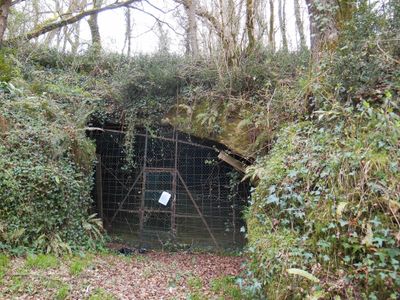
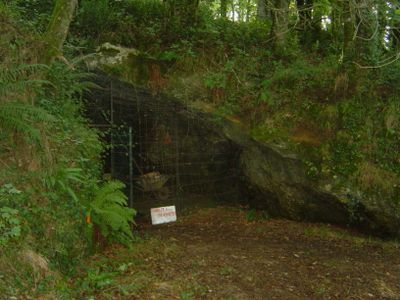
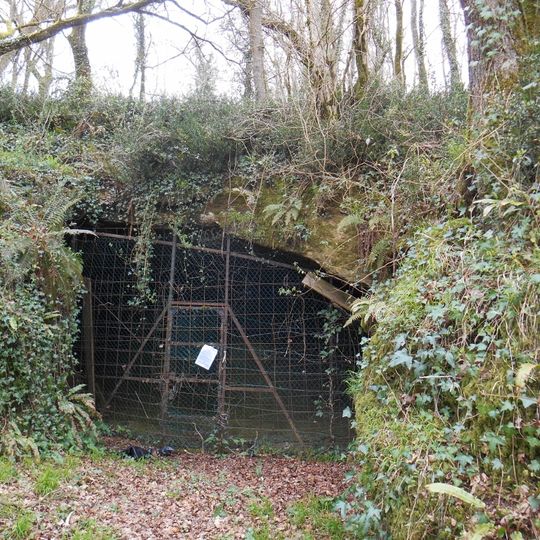
Grotte du Pape is one of four entrances in a karst network that the Pouy stream cut into Eocene limestone on a hillside at Brassempouy. From north to south, the entrances are the Hyènes cave, the Mégacéros gallery, the Dubalen shelter and the Pape cave. The Pape opening is closed by a metal grid; behind it, the interior is dark, and a white sign with red lettering reads "TREUILLES INTERDITES".
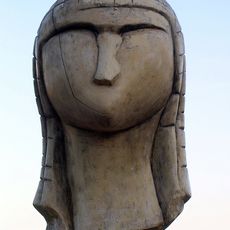
The cave was discovered in April 1880 during work on a quarry access path. Pierre-Eudoxe Dubalen dug there in 1880–1881, Joseph de Laporterie and Albert Léon-Dufour from 1890 to 1892, then Édouard Piette and Laporterie from 1894 to 1897; the Dame de Brassempouy was found in 1894. Henri Delporte excavated from 1981 to 1994, followed by Dominique Buisson and later teams until 2004.
The cave's name comes from a local tradition: the rock shelter was used as a meeting place, and the name "Pape" may refer to a pope who supposedly took refuge there. Excavations at the entrance yielded ivory diadems, pendants, and the statuettes called La Poire (1892) and the Dame de Brassempouy (1894).
The cave entrance is sealed by a metal grid fence, with a white sign reading "TREUILLES INTERDITES" in front; a wheelbarrow sits inside the enclosure. The site lies about 2 km west-southwest of Brassempouy in the Pouy stream valley. The four entrances—grotte des Hyènes, galerie du Mégacéros, abri Dubalen and grotte du Pape—follow one another from north to south on the limestone slope.
The site's "Avenue" layer held finished ivory figurines alongside others broken during carving, indicating a workshop where statuettes were made on the spot. The acidic soil destroyed most organic remains, yet carved bone pieces survived at the Grotte des Hyènes, dating to the early Aurignacian.
The community of curious travelers
AroundUs brings together thousands of curated places, local tips, and hidden gems, enriched daily by 93,677 contributors worldwide.