Théâtre Max-Jacob, Historical theater in Quimper, France.
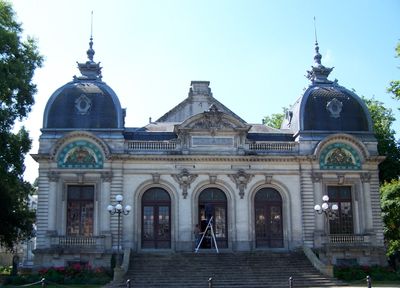
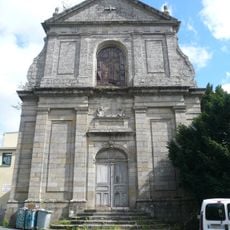
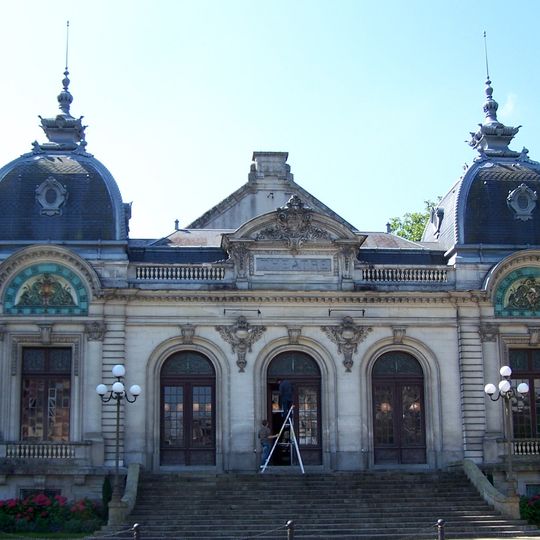
The Théâtre Max-Jacob in Quimper has a symmetrical stone facade with three arched doorways framed by rusticated stonework. Above the central arch, a pediment carries a panel inscribed "THEATRE"; two dark domed corner pavilions with finials and a central triangular gable top the building. Round medallions sit above the side arches, and a staircase leads to the entrance, flanked by two black lamp posts with spherical globes.
In 1893 lawyer Urbain Couchouren left the city a hectare by the Odet on condition it become an old people's home; the council instead built a theatre, funding the hospice elsewhere, which led to lawsuits and a decree signed by President Émile Loubet on 20 August 1899. Nantes architect Georges Lafont's design was built from spring 1902, with facade sculpture by Émile Gaucher and interior decoration by Adrien Karbowsky. The hall opened on 11 February 1904 before some forty local figures, followed by a gala on 19 February. It was renamed Théâtre Max-Jacob in 1997 and listed as a monument historique on 27 August 1997.
The theatre was renamed Théâtre Max-Jacob in 1997, honouring the Quimper-born poet Max Jacob, whose play Le Terrain Bouchaballe dramatised the legal battle over the land the theatre stands on. The building opened in 1904 with a gala performance of Gounod's Mireille and Blainville's Le Baiser.
The theatre stands on the left bank of the Odet, on the plot bequeathed by Urbain Couchouren in 1893. Access is via the staircase leading up to the three arched doorways, flanked by two multi-globe black lamp posts. The building has been inscribed as a monument historique since 27 August 1997.
The theatre's name honours Max Jacob, the Quimper-born poet and playwright whose play Le Terrain Bouchaballe retells the legal battle over the land where the theatre stands. The plot was left in 1893 by lawyer Urbain Couchouren for an old people's hospice; the town built a theatre instead, and a decree signed by President Émile Loubet on 20 August 1899 settled the dispute. The building was renamed for Jacob in 1997.
The community of curious travelers
AroundUs brings together thousands of curated places, local tips, and hidden gems, enriched daily by 94,382 contributors worldwide.