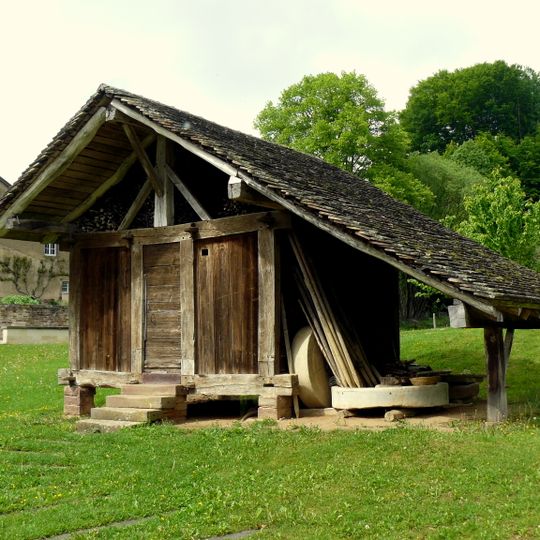
Écomusée du pays de la cerise, Ecomuseum in Fougerolles-Saint-Valbert, France
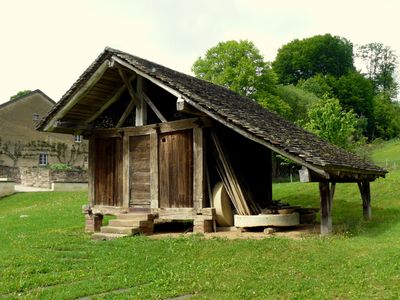
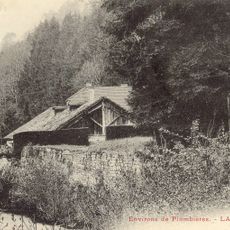
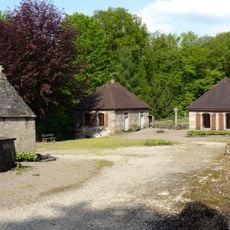
The Écomusée du pays de la cerise occupies a former distillery at 206 Le Petit Fahys, in Fougerolles-Saint-Valbert. The building is larger than a traditional house and combines three parts: the farm, the distillery and the dwelling. A steep shingled roof with exposed timber trusses covers a facade of vertical planks; three wooden steps lead to the central door, and two large circular stone wheels stand under the right overhang.
Desle-Joseph Aubry, a peasant distiller, built the distillery in 1829 and added a still room in 1831; it stayed in operation for over 150 years. Marcel Saire and other Fougerollais collected objects for more than twenty years before founding the ecomuseum in 1982 with SALSA, the DRAC and the municipality. The house was listed in the general inventory of Monuments historiques in 1984, and the museum became a Musée de France in 2003.
The place shows how cherries are grown and turned into spirits, with the work visible from harvest to bottling. Visitors can see how this craft has shaped life in the region for generations.
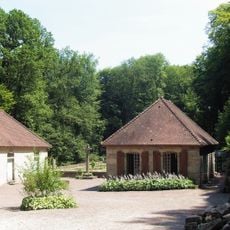
The site sits at 206 Le Petit Fahys, a hamlet of Fougerolles-Saint-Valbert near the RN 57, so it is reached by road. The buildings are spread across a former farm-distillery: the 1829 master's house, the 1831 still room, a servants' house, a chalot and an orchard. A reception building and temporary exhibition room were added in 2001, and the displays were redesigned in 2007.
The distillery was built in 1829 by Desle-Joseph Aubry, a peasant-distiller, with the still room added in 1831. His grandson squandered the family fortune in 1887. The house was listed on the general inventory of Monuments historiques in 1984, and the ecomuseum became a Musée de France in 2003.
The community of curious travelers
AroundUs brings together thousands of curated places, local tips, and hidden gems, enriched daily by 93,261 contributors worldwide.