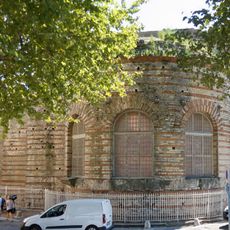
Arles Roman City Walls, Ancient defensive walls in Arles, France.
The Arles Roman City Walls are a fortification system that protected the ancient city and stretches for several kilometers around its perimeter. The structure features stone construction with multiple gates and towers positioned throughout to create a complete defensive network.
The walls were completed under Augustus, built at the end of the 1st century BC as one of the first structures raised after the colony of Arelate was founded, serving both defence and display. Parts were later demolished to make room for the amphitheatre from the end of the 1st century, and in late antiquity the circuit was shortened and reinforced with reused funerary monuments and sculpted pieces of a triumphal arch. Arles fell to the Visigoths in 476, and only in the 13th century was the enlarged city fully enclosed by walls.
The Porte d'Auguste, or Porte d'Italie, was the monumental gate where a branch of the Via Aurelia entered the colony, so the walls marked the arrival of the road from Rome. The Tour des Mourgues, the best-preserved of the flanking towers, still stands along the surviving eastern section.
Several sections of the walls are open to the public and can be explored from different starting points around the city. Wear sturdy footwear since the ground is uneven in places and some routes involve climbing or descending steep sections.
The wall's facing blocks include funerary stones and sculpted pieces from a triumphal arch, reused when the late-antique circuit was shortened and reinforced. Three masonry styles mark three building phases: small regular blocks, large ashlar, then reused megaliths. Look for the Y-shaped rusted iron rod embedded on the left, with plants growing from it.
The community of curious travelers
AroundUs brings together thousands of curated places, local tips, and hidden gems, enriched daily by 94,583 contributors worldwide.