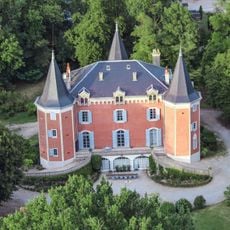
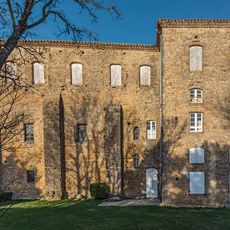
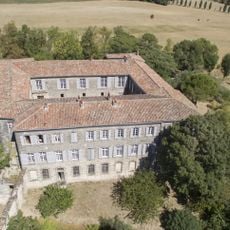
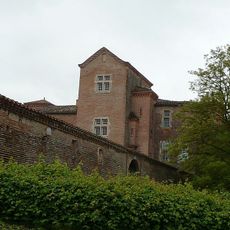
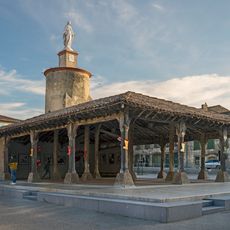
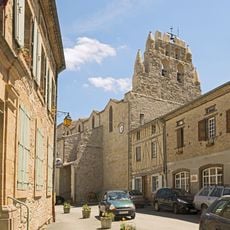
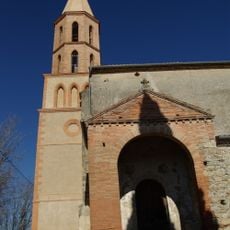
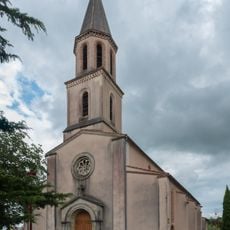
Château de Montgey, Medieval castle in Montgey, France.
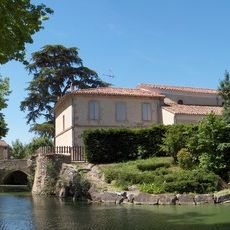
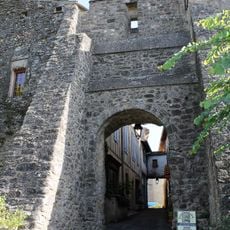
Château de Montgey is a fortified castle on a rocky promontory at 320 m, overlooking the plain from Toulouse to Revel. Its west and partly north walls date from the 12th century and are often more than three metres thick; some Roman-era masonry survives inside the present building. A small crenellated keep rises above the roofs, and a covered gallery and large porch were added to the south facade.
A charter of 1209 attests the castle's existence when it belonged to Jourdain de Roquefort, lord of Montgey from 1209 to 1240. In April 1211, some 5,000 German crusaders marching to reinforce the siege of Lavaur were defeated at the foot of the castle by the Count of Foix, Raymond-Roger, and Jourdain de Roquefort with his villagers. Simon de Montfort retaliated by destroying the village and taking the castle, which Jourdain reoccupied after Montfort's death in 1218.
A sculptured head from Roman times is embedded in the castle walls, showing that people have lived here since ancient periods. This carving reminds visitors of the site's long human story.
The castle is private and only occasionally opens to visitors, notably during the Journées du patrimoine. Access is from the village of Montgey, in the Tarn; the building stands on a rocky promontory at 320 m, overlooking the plain between Toulouse and Revel.
The name Montgey may derive from "Mons Jovis", mountain of Jupiter, and a sculpted Roman head was found built into the castle walls. Pottery fragments such as amphora bases and tegulae still turn up in the surrounding fields, and a Roman camp stood on the neighbouring hill to the east.
The community of curious travelers
AroundUs brings together thousands of curated places, local tips, and hidden gems, enriched daily by 93,621 contributors worldwide.